The Complete Guide to Buying an Exercise Dress: Fabric, Cut, and Fit Explained
Quick Answer: A well-performing exercise dress comes down to four factors — moisture-wicking fabric with the right weight for your activity, a built-in short with proper length and grip, a hem that won’t ride up during movement, and a cut that matches your actual workout type — and getting even one of these wrong is usually why an exercise dress ends up unworn in the closet.
Exercise dresses look simple, but the category has more fit variables than almost any other activewear piece, which is exactly why so many end up disappointing after the first wear.
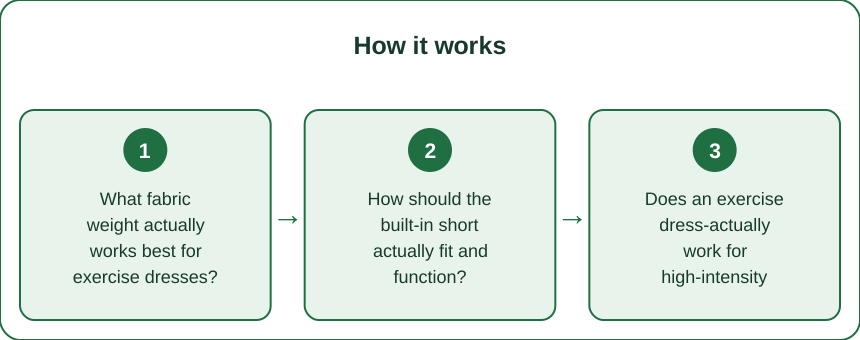
What fabric weight actually works best for exercise dresses?
Fabric weight determines both how much the dress moves with you and how opaque it stays during stretching. Lighter fabrics (around 180-220 GSM) suit low-impact activities like walking or yoga and breathe well in warm weather, while heavier fabrics (240 GSM and above) hold their shape better for higher-impact movement and resist see-through issues during deep bends or squats. A dress that feels great standing still in a fitting room can behave completely differently once you’re actually moving, which is the single biggest fabric mismatch people report.
Moisture-wicking synthetic blends (typically polyester-spandex) remain the standard for actual workout performance, since natural fibers tend to hold sweat and add weight during a sweaty session. If the fabric doesn’t specify a wicking treatment, that’s worth checking before an intense-activity purchase.
How should the built-in short actually fit and function?
The built-in short exists specifically to solve the coverage problem dresses have during high-movement activity, and its length and leg-grip band determine whether it actually works. Shorts that end higher on the thigh tend to ride up more during running or jumping movements, while a slightly longer inseam with a silicone or elastic grip band at the leg opening stays in place through more aggressive movement.
It’s also worth checking whether the short is truly built-in (attached at the waistband, moving as one piece with the dress) versus a separate layer — attached shorts perform more reliably during dynamic movement, since there’s no independent layer to shift or twist relative to the outer dress.
Does an exercise dress-actually work for high-intensity workouts, or is it better suited to low-impact activity?
It genuinely depends on the specific dress’s fabric weight and short design rather than the category as a whole — a well-constructed exercise dress with a heavier fabric and a longer, gripped short can absolutely handle high-intensity intervals or HIIT, while a lighter, shorter-inseam dress is better matched to walking, casual gym sessions, or low-impact studio classes. Buying with your specific primary activity in mind, rather than assuming all exercise dresses perform the same, avoids most disappointment here.
What cut and length actually suits different body types and activities?
A-line and flared cuts tend to allow more unrestricted leg movement for higher-impact activity, while fitted, straighter cuts suit lower-impact activities like yoga or Pilates where a closer fit doesn’t interfere with movement. Length matters similarly — a shorter hem (mid-thigh) allows the most leg mobility for running or jumping, while a longer hem (just above the knee) offers more coverage confidence for activities involving more bending, like gardening-adjacent errands or casual wear-through.
Neither cut is objectively better — the mismatch between cut and activity is what causes the common complaint of a dress ‘riding up constantly’ or ‘restricting movement,’ not the dress category itself.
5 Mistakes Everyone Makes Buying an Exercise Dress
- Buying based on how it looks standing still, without testing a squat or lunge motion in the fitting room.
- Ignoring the built-in short’s grip band, which is the actual determinant of whether it stays put.
- Choosing a fabric weight mismatched to activity — too light for high-impact, too heavy and warm for low-impact summer wear.
- Assuming one exercise dress works for every activity, rather than matching cut to actual primary use.
- Skipping a movement test in natural light, which reveals see-through issues that studio lighting can hide.
How do you actually test an exercise dress before committing to it?
The most reliable test is a squat, a lunge, and a raised-arm reach, done in the fitting room before removing tags — this reveals whether the hem rides up, whether the built-in short shifts, and whether the fabric goes sheer under stretch. Doing this in front of a window with natural light, rather than only studio lighting, also catches opacity issues that indoor lighting frequently masks.
FAQ: Exercise Dresses, Answered
Are exercise dresses actually practical, or mostly for looks?
When fabric weight and short design match the activity, they’re genuinely practical — the ‘looks over function’ reputation mostly comes from mismatched purchases, not the category itself.
Should the built-in short be tight or loose?
Snug enough to stay in place without shifting, but not so tight it creates a compression line that’s uncomfortable during extended wear.
How many exercise dresses does someone actually need in rotation?
Most people find 2-3 covering different activity intensities (one lighter for low-impact, one heavier for high-intensity) covers the range without excess.
TL;DR:
- Fabric weight should match your actual activity intensity, not just how it feels standing still
- The built-in short’s length and grip band determine whether it stays in place during movement
- Cut and hem length should match your primary activity — no single style fits every use
- Always test with a squat, lunge, and reach in natural light before buying
- 2-3 dresses covering different intensities beats one dress expected to do everything
An exercise dress that disappoints is almost always a fit-to-activity mismatch, not a flaw in the category itself — matching fabric and cut to what you’ll actually do in it solves most of the common complaints.
Keep Reading
This article is for general informational and styling purposes only. Fit, sizing, and product availability may vary.