The Complete Guide to Wearing an Exercise Dress on a Windy Day
Quick Answer: Wind lifts a skirt because moving air over the outside of the fabric drops the pressure there relative to the still air underneath - the same effect that lifts a wing. The three construction details that resist it are hem weight (heavier or wider hem fabric), skirt volume (less flare means less surface for air to get under), and a genuine attached short that makes lift a cosmetic issue rather than a coverage one. If you already own a dress you like, the highest-value changes are wearing a longer built-in short, choosing a heavier fabric weight, and understanding that a side slit is far worse in wind than a pleat.
The dress is perfect on a calm day. Then you step out from behind a building, get a crosswind, and spend the next forty minutes with one hand occupied.
Wind is the variable that separates dresses that work in real life from dresses that work in a photograph, and it is not really about the length.
It is about how much air can get underneath, and how much the hem weighs when it does.

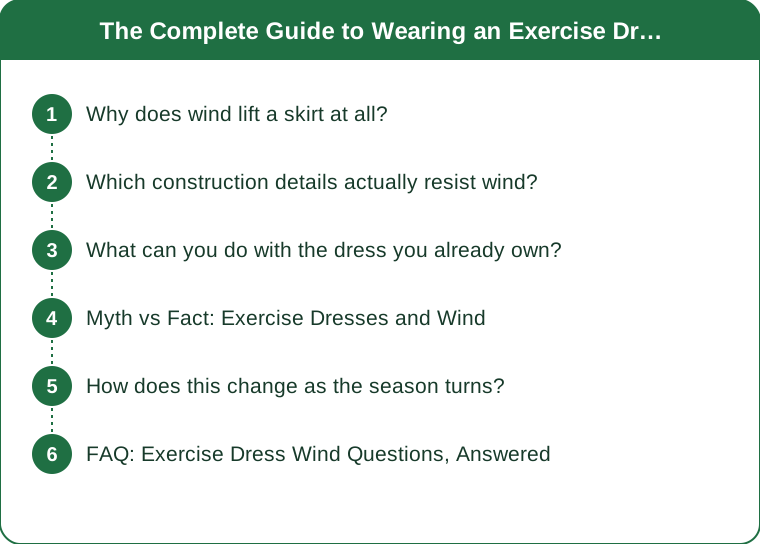
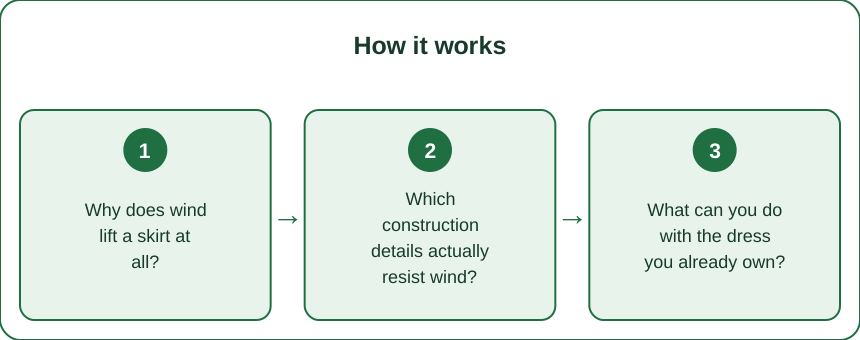
Why does wind lift a skirt at all?
Because the air moving across the outside of the fabric is at lower pressure than the still air trapped underneath it.
This is the same principle that generates lift on an aircraft wing, applied to something considerably less engineered. Fast-moving air exerts less sideways pressure than still air. When wind passes over the outer surface of a skirt while the air inside stays relatively still, the pressure difference pushes the fabric outward and upward.
This explains several things that otherwise seem inconsistent:
Why it happens without a gust from below. People assume wind has to get under the hem to lift it. It does not - a purely horizontal crosswind produces lift, because the mechanism is pressure difference rather than a physical push.
Why walking makes it worse. Movement creates relative airflow even on a still day, and it repeatedly opens the gap at the hem, letting air move in and out.
Why it is dramatically worse in certain places. Between buildings, at the top of stairs, at a corner, stepping out of a car. Wind accelerates when it is channelled, and channelled wind is what catches people.
Why heavier fabric behaves so differently. Lift has to overcome the weight of the fabric. Double the fabric weight and the same wind produces roughly half the displacement. This is why fabric weight matters more than any other single specification for a windy day, and it is almost never on the label.
And why a slit is the worst feature. A slit provides a direct opening for air to enter beneath the skirt, and once air is underneath, it inflates rather than lifting one edge. A pleat, by contrast, allows movement without creating an opening.
Which construction details actually resist wind?
There are four, in descending order of how much they matter.
Fabric weight, first and by some distance. A heavier knit resists lift proportionally. In practical terms, a dress that feels substantial in your hand and drapes downward when held from the shoulders will behave far better than one that feels airy and floats. Lightweight moisture-wicking fabrics are excellent in heat and poor in wind - that is a real trade-off, not a quality difference.
Skirt volume. More flare means more surface area for air to act on and more room underneath for it to sit. An A-line with modest flare handles wind far better than a full circle skirt. The counterintuitive part is that a narrower skirt is often more comfortable in wind even though it restricts movement more - there is simply less to catch.
Hem construction. A wide, doubled hem adds weight exactly where it does the most good, at the outer edge where the lever arm is longest. A rolled or raw-edge hem adds almost nothing. Some dresses use a bonded or banded hem specifically for this, and it works.
The built-in short, which changes the stakes rather than the physics. A genuine short with a decent inseam does not stop the skirt lifting. What it does is convert lift from a coverage problem into a cosmetic one, which is the difference between adjusting constantly and not caring. Inseam length is the specification to check - a very short built-in short offers less real coverage than the skirt did.
A fifth, minor factor: skirt attachment. A skirt gathered onto the waistband has more fabric and more volume than one that is smoothly attached, and gathers give air more purchase. This is a small effect compared with weight, but it is visible when comparing two otherwise similar dresses.
What can you do with the dress you already own?
Most of the useful interventions do not require buying anything.
Wear a longer short underneath. The simplest and most effective change. A bike short with a five to seven inch inseam under the dress removes the coverage question entirely, and in a matching or neutral colour it is invisible unless the skirt lifts - at which point it is doing its job. This single change makes almost any dress wind-viable.
Add weight at the hem, temporarily. Small sew-in drapery weights or a strip of fusible hem tape at the front and back hem add just enough mass to change the behaviour. This is a genuinely old solution and it works precisely because the physics has not changed.
Choose a longer length for windy conditions. A longer skirt has more mass, hangs lower, and has a longer distance to travel before coverage is affected. If you own two lengths, the longer one is the windy-day one.
Layer a light jacket that sits at or below the waist. It reduces the wind reaching the top of the skirt and stops the whole garment being pushed sideways from the waist up.
Watch where you walk. Corners, gaps between buildings, the exposed side of a car park, the top of a flight of outdoor steps. These are all wind-acceleration points and they are predictable.
And a practical one: check the direction as you leave. A tailwind is barely noticeable and a headwind is manageable. A crosswind is the one that causes problems, and knowing you have one before you have committed to a route lets you choose the sheltered side of the street.
The one thing not to do is buy a heavier dress you will only wear on windy days. Most people’s actual solution is a decent pair of shorts underneath and a slightly longer built-in inseam next time they buy.

Myth vs Fact: Exercise Dresses and Wind
Myth: A longer dress solves the problem. Fact: Length helps, mostly by adding weight and travel distance, but a long lightweight skirt in a strong crosswind lifts just as readily as a short one - it simply has further to go. Weight and volume matter more than length.
Myth: The built-in short makes wind irrelevant. Fact: It makes coverage a non-issue, which is most of the discomfort. But a very short built-in short - and many are shorter than people expect - provides less coverage than the skirt does, so it solves the problem only if the inseam is genuinely long enough.
Myth: Tighter skirts do not blow up. Fact: They lift less because there is less fabric and less air underneath, but a fitted stretch skirt can ride up rather than lift, which is a different problem with the same outcome. There is no shape that is immune.
Myth: This only matters at the coast or on a hilltop. Fact: Urban wind between buildings is frequently stronger and far less predictable than open-country wind, because the airflow is being channelled and accelerated. The worst gust most people experience in a week is stepping out of a doorway onto a street.
Myth: Static cling makes it worse. Fact: The opposite - static makes fabric cling to the legs, which reduces lift. It causes its own problems, and those become more common as the air dries out heading into autumn, but wind lift is not one of them.
Myth: You can weight the hem by putting things in the pockets. Fact: Pockets are almost always positioned at hip level rather than at the hem, so the weight is in the wrong place to do anything about lift. It does help stop the whole skirt swinging, which is a smaller and different benefit.
How does this change as the season turns?
Late August and September change the calculation in three ways that are worth planning around.
Wind gets more frequent and less predictable. The transition period between summer and autumn produces more unsettled conditions than midsummer does. A dress that worked reliably all July starts having windy days in September, which is why this problem seems to appear from nowhere at this time of year.
The layering underneath changes and helps. Once you are wearing longer shorts or a light legging beneath the dress for warmth, the coverage question resolves itself. The transitional dress outfit - dress, longer bike short or cropped legging, light jacket - is genuinely more wind-tolerant than the summer version, and it is what extends a summer dress into October.
Fabric weight preferences shift naturally. The heavier knits that feel too warm in August are exactly the ones that handle wind well. This is convenient: the dresses you reach for as it cools are already the better windy-day options.
One thing that gets worse: wind chill on bare legs is significant. A 15°C day with wind feels considerably colder than a still 15°C day, and legs lose heat quickly. This is usually what ends dress season rather than temperature alone, and adding a legging underneath extends it by several weeks.
And a small practical note for the transition: if you are choosing a dress now that you want to wear into October, the two specifications to prioritise are a built-in short with a real inseam and a fabric with some substance to it. Both make the dress more useful in wind and more useful in cool weather, which is the same set of days.
FAQ: Exercise Dress Wind Questions, Answered
What length short should be built in?
Look for something in the range of four to seven inches of inseam. Below about three inches, the short provides less coverage than the skirt does when the skirt is behaving, which means it only helps in the specific moment of lift. Longer built-in shorts also reduce chafing on longer efforts, so the specification is worth checking for more than one reason.
Is there a fabric that just does not blow up?
Not exactly, but weight is the closest thing. A ponte-style or heavier double-knit skirt resists lift dramatically better than a lightweight woven or a fine jersey, at the cost of being warmer and slower to dry. If you play outdoor racquet sports or walk on exposed ground regularly, that trade is usually worth making.
Can I add hem weights to a dress I already own?
Yes, and it works well. Small sew-in weights - the kind used for curtains and jacket hems - placed at the front and back hem, or a strip of fusible hem tape all the way round, add the mass exactly where it is most effective. It costs very little and it does not change how the dress looks or feels when there is no wind.
TL;DR:
- Wind lifts a skirt through pressure difference, not by getting underneath - which is why a horizontal crosswind is the worst kind.
- Fabric weight matters more than length. Double the weight, roughly halve the lift.
- A slit is far worse than a pleat - it lets air in underneath, which inflates rather than lifts.
- The best fix for a dress you already own: a longer short underneath, plus hem weights if you sew at all.
- The transitional autumn version - dress, longer short or legging, light jacket - is genuinely more wind-tolerant than the summer one.
Wind is not a reason to give up on the dress. It is a reason to check one specification - the built-in inseam - and to keep a pair of longer shorts in the drawer.
See It in Motion
Seen here: Super High Waist Embossed Yoga Leggings with Inner Pocket — shop it on bubblelime.com
Keep Reading
This article is for general informational and styling purposes only. Fit, sizing, and product availability may vary.