The Complete Guide to Buying an Exercise Dress That Actually Works
Quick Answer: Judge an exercise dress on five things: the built-in shorts (length, grip, and whether they twist), the bra construction (shelf versus proper support), the fabric weight in the skirt versus the bodice, the length relative to your torso rather than your height, and the seam placement at the underbust. Almost every abandoned exercise dress failed on the shorts or the bra, and neither is visible in product photos.
This is the full version, including the specific failure modes and how to test for each before the return window closes.

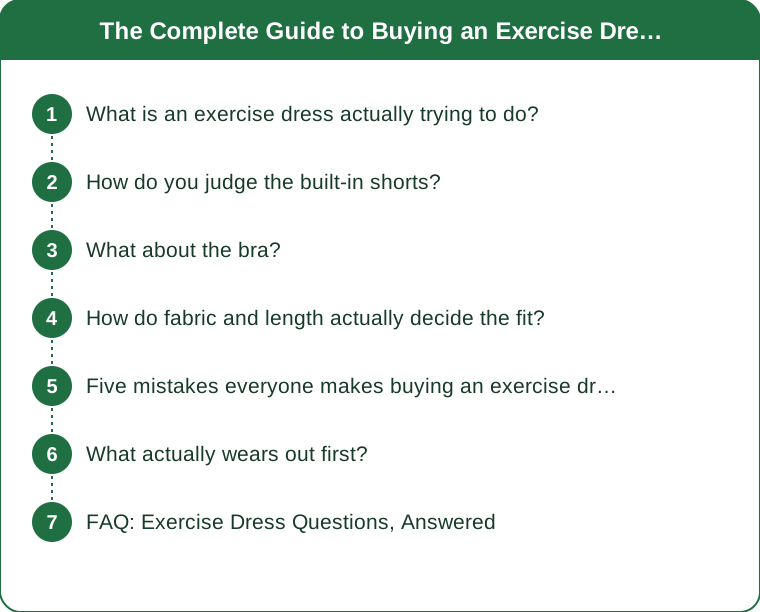
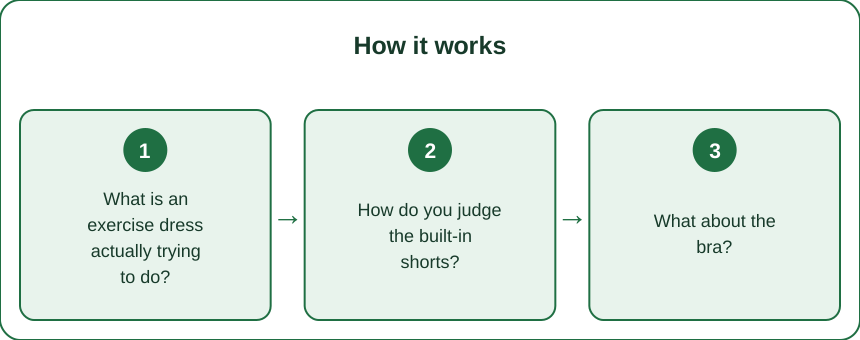
What is an exercise dress actually trying to do?
It is solving a specific problem, and understanding that problem tells you which compromises matter.
The core proposition is one garment instead of three. A bra, a top, and shorts become a single item, which removes the coordination problem, the gap-at-the-waist problem, and the packing problem. That is a genuine convenience and it is why the category grew as fast as it did.
The engineering challenge is that those three garments have contradictory requirements. A bra needs to be tight and stable. A skirt needs to move freely. Shorts need to grip the leg without riding. Combining them into one piece means the tension of the bra is transmitted through the bodice into the skirt, and the movement of the skirt pulls back on the bra. Every design decision in an exercise dress is managing that conflict, and the ones that fail have not managed it.
The category also spans very different intended uses. A tennis-oriented dress prioritises range of motion at the shoulder and a skirt that moves. A hiking or travel dress prioritises pockets, coverage, and durability. A casual athleisure dress prioritises how it looks standing still. Buying a dress designed for one and using it for another is the most common source of disappointment, and the product page rarely says which it is.
Which means the first question is not which dress, but which use. If you want it for tennis and you buy one designed for airport travel, the failure is not the garment’s.
How do you judge the built-in shorts?
This is where most exercise dresses fail, and it is almost never photographed.
Length is the first thing. Built-in shorts that end above mid-thigh will ride up on anyone whose thighs touch, and they will ride up progressively through a day rather than immediately, which is why the shop test does not catch it. Look for shorts reaching at least mid-thigh and preferably a little longer.
Grip at the hem matters more than length. A silicone gripper strip or a wide, snug band at the hem prevents ride-up in a way that a plain hem does not. A plain-hemmed short in a slippery fabric will migrate regardless of length.
Twisting is the underrated failure. Shorts attached to the dress at the waist only, with no anchoring below, rotate around the leg during walking. The seam that started at the inner thigh ends up at the front. This is genuinely maddening and it is determined by construction rather than by fit, so no amount of sizing fixes it.
Fabric weight of the shorts should be lighter than the skirt, not the same. Shorts as heavy as the outer layer make the whole garment hot and add bulk at the hip.
Check whether the shorts are attached or separate. Attached is more secure and harder to wash well. Detachable — where offered — is more versatile and occasionally less stable. Both work; knowing which you have prevents the surprise.
The test: walk for ten minutes at pace indoors, including stairs. Ride-up and twisting both show within that window, and both are grounds for a return.
What about the bra?
The second major failure point, and the one that determines whether the dress works for actual exercise.
A shelf bra is not a sports bra. A shelf is a layer of fabric with an elastic band, offering light shaping and minimal support. It is fine for walking, travel, and casual wear. It is not adequate for running or anything with sustained impact, and for larger cup sizes it is not adequate for much at all.
Look for what the construction actually is: a shelf with a band, a shelf with removable cups, or a genuine built-in bra with separate cup shaping and a wider underband. The third is rare and it is what makes a dress usable for real exercise.
The underband is the tell. Support in any bra comes overwhelmingly from the band, not the straps. A wide, firm underband that sits level and does not ride up indicates real engineering. A narrow elastic sewn into a seam does not.
Removable cups are a mixed blessing. They improve appearance and modesty and they are the single most common thing to bunch, fold, and come out in the wash. If the dress has them, check whether they sit in a proper pocket or float.
The straps matter for a specific reason: because the bra is integrated, the straps also carry the weight of the entire dress. A dress with a heavy skirt and thin straps puts all of that load on the shoulders and traps, which becomes noticeable within a couple of hours.
If you need real support, the honest answer is often to buy a dress with a light shelf and wear your own sports bra underneath. Several designs accommodate this well. It defeats part of the one-garment proposition and it is far better than a dress you do not wear.

How do fabric and length actually decide the fit?
Two variables that get chosen by appearance and should be chosen by measurement.
Skirt fabric weight determines the drape and the wind problem. A very light skirt moves beautifully and lifts in wind, on stairs, and getting out of a car. A heavier skirt hangs, resists wind, and reads as more substantial — but adds warmth and can look bulky at the hip. For late-summer heat, a mid-weight skirt with some drape is the compromise most people are happiest with.
Bodice fabric should be a compression-capable knit. If the bodice is the same light fabric as the skirt, it will not hold the bust stable regardless of what the shelf does. Good dresses use a different, firmer fabric above the waist, and this is visible in the product photos if you look for a change in surface.
Length should be judged against your torso, not your height. Two people of the same height with different torso-to-leg ratios will get very different results from the same dress, because the waist seam lands in a different place. Find the stated waist-seam-to-hem measurement rather than the total length, and compare it to a skirt you already own and like.
The seam at the underbust is the single most consequential piece of construction. If it sits at your actual underbust, the dress fits well and the bust is supported. If it sits above or below, nothing else in the garment can compensate — the skirt hangs from the wrong point and the bra pulls against it all day. This is why exercise dresses fit some people beautifully and others badly at every size.
Pockets: side pockets in the shorts are the most useful and the least likely to bounce. Skirt pockets swing. A phone in a skirt pocket during any activity is a pendulum, and it is the pocket configuration most often regretted.
Five mistakes everyone makes buying an exercise dress
1. Buying for the activity you aspire to rather than the one you do. The dress bought for tennis and worn for errands is a common and harmless version. The dress bought for errands and taken to a tennis court is not. Buy for the actual use.
2. Testing it standing still in front of a mirror. Every failure mode in this category — ride-up, twist, bounce, wind lift, strap dig — appears in motion and none appear standing. Walk, climb stairs, sit down, get up, and reach overhead before the return window closes.
3. Sizing by dress size rather than by underbust. The underbust seam placement decides the fit, so the relevant measurement is the one that determines where that seam lands. People routinely size up for the hips and end up with a bodice that does nothing.
4. Ignoring the care label. Integrated cups, elastic shelf bands, and attached shorts all make a dress harder to wash well and easier to ruin. Anything requiring hand washing will be worn less, regardless of how good it is.
5. Assuming a higher price means better support. Price in this category correlates with fabric quality and design, and only weakly with bra construction. Some of the most expensive dresses have the flimsiest shelves, because they were designed as travel and lifestyle garments rather than as exercise ones.
The third mistake is the one that produces the most returns, and it is entirely avoidable with a tape measure.
What actually wears out first?
Knowing the failure points tells you what to inspect before the return window and what to expect over a season.
The shorts hem goes first. The inner thigh of the built-in short is the highest-abrasion point in the whole garment, and it is where thinning, pilling, and eventually splitting appear. Check it after ten wears — if it is already fuzzy, the fabric is too light for the construction and it will not last a season.
The shelf bra elastic goes second. The underband elastic loses recovery faster than the main fabric, particularly if the dress is machine dried. A shelf that no longer sits snug turns a functional dress into a casual one, and there is no repair for it.
The skirt attachment seam is the third. Because the skirt’s weight and movement pull against a single horizontal seam, that seam takes repeated stress. Puckering along it is normal; visible thread strain is not.
Colour goes at the shoulders. Sunscreen and sun exposure both concentrate there, and on a dress worn outdoors through a summer the shoulders fade measurably faster than the rest.
What extends the life meaningfully: wash cold and inside out, fasten nothing that could snag, air dry flat rather than hanging — a heavy wet skirt hanging from thin straps stretches them permanently — and remove the cups before washing if they are removable. The hanging-wet mistake is the most common one specific to this category, because it is not an issue with any other activewear item.
Realistic lifespan: a well-made dress worn twice a week and cared for properly gives two seasons. One machine-dried on hot gives considerably less than one.
FAQ: Exercise Dress Questions, Answered
Can I wear a regular sports bra underneath?
Often yes, and it is a good solution when the built-in shelf is inadequate. Look for a dress with wider straps or a racerback so the bra straps are covered, and check that the bodice is not so tight that layering creates bunching at the underbust.
Are they suitable for running?
Depends entirely on the bra and the shorts. A dress with a genuine built-in bra and gripped mid-thigh shorts runs well. A shelf-bra dress with short, plain-hemmed shorts does not, and no styling fixes either problem.
How do I stop the skirt lifting in wind?
Mid-weight fabric rather than very light, a slightly longer length, and a skirt with more panels — more seams means more structure and less lift. A very light A-line skirt in a windy month is an unforced error, and late August into September is when that becomes relevant again.
Do they work into autumn?
Well, with layers. Long-sleeve fitted top underneath, tights or leggings beneath the shorts, and a jacket over the top. The dress becomes the mid layer, which is a genuinely useful second life and extends the wear window by a couple of months.
TL;DR:
- Decide the use first — tennis, hiking, travel, and casual dresses are engineered differently and are not interchangeable.
- Built-in shorts need mid-thigh length, a gripper or snug band at the hem, and anchoring that stops them twisting.
- A shelf bra is not a sports bra; the underband width tells you whether there is real support, and layering your own bra is a legitimate fix.
- Judge length by the waist-seam-to-hem measurement against your torso, not by total length against your height.
- The underbust seam placement decides the whole fit — size by underbust, not by dress size.
- Test in motion within the return window: walk, stairs, sit, stand, reach overhead.
- Mid-weight skirt fabric with more panels solves wind lift; skirt pockets swing and shorts pockets do not.
The two things that decide whether you keep wearing it — the shorts and the bra — are the two things no product photo shows. Test both in the first week.
See It in Motion
Seen here: Racerback Tank Top - White — shop similar styles on bubblelime.com
Keep Reading
This article is for general informational and styling purposes only. Fit, sizing, and product availability may vary.