The Exercise Dress Length Problem Nobody Solves for Petite and Tall Bodies
Quick Answer: Exercise dresses are graded for length far less than they are graded for width, so a size run mostly changes circumference while the hem and the built-in short stay close to the same length. At 5 feet 2 that puts the hem low and the short visible; at 5 feet 10 it puts both too high. The fix is to shop by two measured numbers — shoulder-to-hem and inseam of the built-in short — and to ignore the size chart’s height range entirely.
You bought the size the chart told you to. It fits perfectly across the shoulders and the waist. And the hem is either three inches lower than the photograph or three inches higher, and the built-in short is doing something entirely different on you than on the model.
This is not a fit failure. It is a grading decision, and once you know how it works you can buy around it.
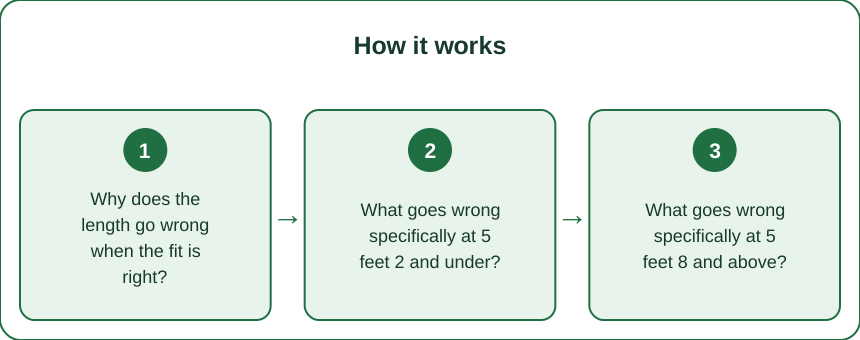
Why does the length go wrong when the fit is right?
Because grading is mostly horizontal.
When a garment is graded from a sample size up and down a run, the pattern is expanded and contracted according to a set of increments. Circumference measurements — bust, waist, hip — receive substantial increments, because that is what differs most predictably between sizes. Vertical measurements receive much smaller ones, and in a lot of activewear they receive almost none.
There are commercial reasons for this. Vertical grading complicates the pattern, increases fabric consumption in the larger sizes, and — critically for a dress with a built-in short — requires the inner short to be graded on its own separate curve. Many brands simply do not, and use one or two short lengths across the entire run.
The practical result: an XS and an XL from the same brand may have a shoulder-to-hem difference of an inch or less, while the size chart implies they are for bodies of very different proportions. The dress that hit mid-thigh on the 5 feet 9 fit model hits below the knee on someone at 5 feet 2 in the same nominal length.
The second layer of the problem is that height is not distributed evenly between people of the same height. Two women at 5 feet 6 can differ by three inches in leg length and torso length in opposite directions. A dress is a garment whose entire behavior depends on where the hem lands relative to the thigh, which means it depends on leg length — a measurement no size chart asks you for.
This is why the reviews for any given exercise dress are so polarized on length specifically. The garment is not inconsistent. The bodies are, and the grading is not accounting for it.
What goes wrong specifically at 5 feet 2 and under?
Four things, in descending order of how often they end the relationship with the dress.
The hem lands too low and kills the proportion. A dress designed to sit mid-thigh sitting at or below the knee reads as a different garment entirely — closer to a tunic — and loses the leg line that makes the silhouette work. This is the reason most petite returns happen, and it is a proportion problem rather than a coverage one.
The built-in short peeks. If the short was graded shorter than the outer hem by a fixed margin on a tall fit model, and the outer hem has come down but the short has not, the margin shrinks or inverts. A visible inner short at the hem is the specific complaint you will find repeatedly in petite reviews.
The armhole and waist seam sit wrong. A dress with a defined waist seam graded without vertical adjustment puts that seam below your natural waist, which drops your apparent waistline and shortens the leg further. The same effect happens with a princess seam or a bust dart landing low.
The built-in bra shelf sits low. This is the one with actual functional consequence rather than aesthetic. A shelf bra that lands below the fullest part of the bust provides no support at all and produces a band that rides up during activity. If you are shorter through the torso, this is the measurement to check first, because everything else is fixable and this is not.
What to do: look for brands with a genuine petite run rather than a shorter size, and check whether the product page lists a shoulder-to-hem measurement per size — a brand that lists it per size is grading it. Failing that, buy the dress that is intended to be longer on a tall body and accept it as a mini-length dress, which is a perfectly good outcome and is what most people at this height eventually do.
What goes wrong specifically at 5 feet 8 and above?
The opposite set, and they are harder to solve.
The hem lands too high for the activity. A dress meant to hit mid-thigh hitting at the very top of the thigh changes the coverage math completely. On a tennis court, on a bike, or reaching up to a shelf, that difference is the difference between a garment you can stop thinking about and one that requires constant management. The visible-short question becomes constant rather than occasional.
The short becomes the outfit. For most tall wearers the inner short ends up visible in normal movement, which means it is functioning as visible shorts. If it is a plain black compression short and the dress is patterned, this looks like a mistake. If you know it in advance, you can buy for it — pick dresses whose inner short matches the outer fabric or is deliberately contrasting rather than a default black.
The waist seam sits high, at the ribcage. This is the most visually obvious tall-specific problem, and it is why a dress that is nominally fine can look distinctly childlike on a long torso. Empire-line placement on someone it was not designed for is not a subtle effect.
The shelf bra pulls down at the band. Long torso plus non-graded vertical means the shelf is being asked to span further than intended, and the tension goes into the band, which then digs. The complaint is usually described as the dress feeling short in the body, which is exactly what it is.
What to do: look at brands with an explicit tall range, and prioritize dresses with a dropped or undefined waist over a seamed one — an A-line or trapeze cut has no waist seam to land in the wrong place, which makes it dramatically more forgiving of torso length. Also consider sizing up purely for length and taking in the width, which is a genuinely easy alteration on a knit and one most tailors will do for very little.
Which two measurements should you actually shop by?
Shoulder-to-hem, and the inseam of the built-in short. Everything else is noise.
Shoulder-to-hem is measured from the highest point of the shoulder seam straight down to the bottom of the outer hem. This single number tells you where the dress will land on you, and unlike a stated dress length it accounts for the shoulder construction. Take a dress you already own and like, lay it flat, measure it, and write the number down. That is now your target.
The built-in short inseam is the distance from the crotch seam to the bottom of the inner short. This determines whether the short is visible and whether it will ride. Most exercise dresses use between two and four inches. Anything at two inches is going to ride on any thigh that touches, regardless of your height. If you have a pair of shorts you know works, measure those.
How to use them: email the brand, or check whether the product page has a measurements tab. A surprising number do, and a customer service reply with the shoulder-to-hem for two sizes takes a day and saves two returns. If they cannot tell you, that is information too — brands that do not know their own vertical measurements are the ones that are not grading them.
A third number, if you have a specific concern: the distance from shoulder to the top of the built-in bra band. This predicts the shelf bra problem better than anything else and almost nobody asks for it.
Write these three numbers in your phone. The whole category becomes shoppable rather than a lottery, and it is portable between brands in a way that a size never is.
Myth vs Fact: Exercise Dress Length
Myth: Sizing up gives you more length. Fact: It gives you a little, and mostly it gives you width. In a run graded primarily horizontally, going up one size might add half an inch to the hem and two inches to the hip. You end up with a loose dress that is still the wrong length. This is the most common and most expensive mistake in the category.
Myth: The built-in short is meant to be invisible. Fact: Design intent varies, and a lot of dresses are designed with a deliberately visible short. The problem is not visibility, it is unintentional visibility — a black short under a patterned dress reads as a mistake, the same short under a matching dress reads as the design. If yours shows, lean into it rather than fighting it.
Myth: A longer dress is always more modest. Fact: Coverage during movement depends on the inner short, the hem circumference and the fabric weight, not on hem length. A long, light, narrow-hemmed dress rides more than a shorter one with a wide sweep and a four-inch short. Length is the least predictive of the four.
Myth: Petite ranges are just the same dress made smaller. Fact: A real petite range is regraded vertically — the waist seam, armhole depth and bra shelf all move up, not just the hem. This is why a genuine petite dress fits so differently from a small in the standard run, and it is worth paying for if you are under about 5 feet 3.
How do you fix a dress you already own and cannot return?
Most of these are more fixable than they look, and one is not.
Too long, at the hem: the easiest alteration in the category. A knit hem can be shortened and coverstitched by any alterations shop for a small amount, and if the dress has a plain hem you can even do it yourself with a twin needle. Take up less than you think — an inch changes the proportion noticeably.
Too long, and you want to keep it: wear it as the tunic it has become, over leggings or a longer bike short. This is a genuinely good outcome for autumn, and it extends a summer dress into the cool months at no cost.
Inner short visible and you do not want it: cut the short out entirely and wear your own underneath. The short is usually attached at the waist seam only and can be removed with a seam ripper in ten minutes without touching the outer dress. Replace with a matching bike short and the dress becomes considerably more versatile.
Inner short too short and it rides: this is not fixable, but it is bypassable — remove it as above and substitute a four-inch short with a silicone or grippy hem.
Waist seam in the wrong place: not practically fixable. This is the one to accept or to sell on.
Shelf bra too low or unsupportive: remove it and wear a proper sports bra underneath. Almost everyone above a C cup ends up here anyway, and a dress with the shelf removed is often noticeably more comfortable and considerably easier to wash.
Hem too short for the activity: wear it with a longer bike short deliberately visible beneath. This is a very common styling choice on tennis courts and it looks intentional because it is.
FAQ: Exercise Dress Fit Questions, Answered
Is there a height where exercise dresses just do not work?
No, but there is a height range they are designed for, and it is roughly 5 feet 5 to 5 feet 8. Outside that you need to shop by measurement rather than size, and you need brands that grade vertically. Both ends of the range have workable options; you just cannot buy on a size chart alone.
Should I buy the tennis version or the general activewear version?
Tennis-specific dresses almost always have a better inner short — longer, with a real gripper, and often with ball pockets that require it to stay put. If the length behavior of the short is your main problem, the tennis category solves it more often than the lifestyle category does.
Will washing shrink it enough to fix a too-long dress?
Do not plan on it. Modern activewear blends are dimensionally stable and any shrinkage will be in width as much as length. Deliberately hot-washing an exercise dress to shorten it damages the elastane and produces a dress that is still too long and now baggy.
Does the same problem affect skorts?
Less, because a skort’s outer layer is short by definition and the inner short is the functional garment. If exercise dress length is a persistent problem for you, a skort plus a separate top solves it entirely at the cost of one extra garment — and it lets you buy the short and the top in different sizes, which is the real advantage.
TL;DR:
- Exercise dresses are graded mostly horizontally, so the hem and the inner short barely change across a size run.
- Under 5 feet 3, the hem drops, the waist seam sinks and the bra shelf lands low; over 5 feet 8, everything sits too high and the inner short becomes visible.
- Shop by two measured numbers — shoulder-to-hem and inner short inseam — and ignore the height range on the chart.
- Sizing up for length is the expensive mistake; it adds width, not length.
- Most problems are fixable after the fact except a waist seam in the wrong place.
Take five minutes with a tape measure on a dress you already like, put three numbers in your phone, and the entire category stops being a lottery. It is the least exciting fitting-room advice there is, and it has a better return rate than any amount of reading reviews.
See It in Motion
Seen here: Super High Waist Embossed Yoga Leggings with Inner Pocket — shop it on bubblelime.com
Keep Reading
This article is for general informational and styling purposes only. Fit, sizing, and product availability may vary.