Why the Same Exercise Dress Feels Perfect in Spring and Wrong by Midsummer
Quick Answer: Exercise dresses are built on a spectrum of fabric weights, and a mid-weight dress that felt ideal in March can feel noticeably heavy and clingy by July, not because it changed, but because your body’s cooling needs did. Owning at least two weights — one lighter, one heavier — solves more of this than any single “do it all” dress can.
You pull out the exercise dress that was your go-to a few months ago, and it suddenly feels wrong: heavier, clingier, less breathable than you remember. It didn’t change. The season around it did, and fabric weight is the single biggest reason a favorite piece can feel like a completely different garment across a year.
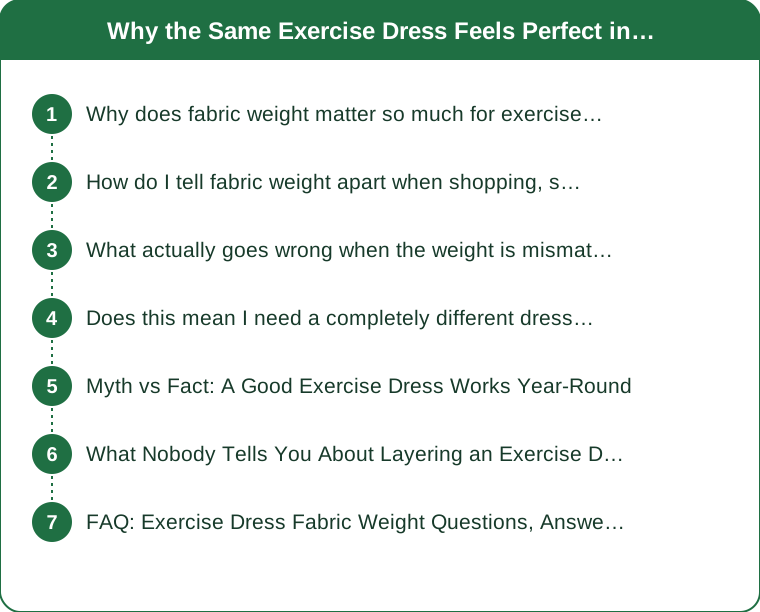
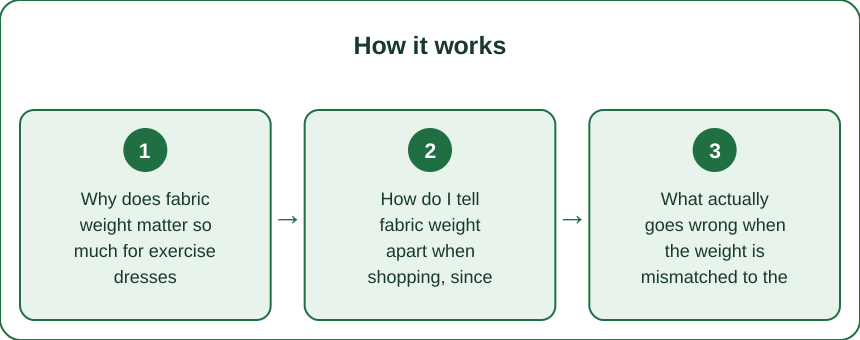
Why does fabric weight matter so much for exercise dresses specifically?
An exercise dress covers more surface area than a top-and-shorts combination, so its fabric weight has an outsized effect on heat retention compared to smaller separate pieces. A mid-to-heavy weight fabric that provides useful compression and opacity in cooler weather becomes a heat-trapping liability once temperatures and humidity climb.
This matters more for dresses than for leggings or tops specifically because there’s more total fabric in continuous contact with your torso, with fewer natural ventilation gaps than a two-piece outfit provides.
How do I tell fabric weight apart when shopping, since it’s rarely labeled clearly?
Check the fabric weight in grams per square meter (GSM) if listed — anything under roughly 180 GSM tends to run lighter and more breathable, while 220+ GSM fabrics run heavier and warmer, generally with more opacity and compression as a tradeoff.
When GSM isn’t listed, the stretch-and-recovery test works as a proxy: heavier fabrics resist stretching and snap back firmly, while lighter fabrics stretch more easily and feel noticeably thinner between your fingers.
What actually goes wrong when the weight is mismatched to the season?
In summer, a heavy dress traps heat and moisture against the torso, leading to chafing at the waist and thigh seams that wouldn’t happen in cooler, drier conditions with the same design. In winter, an overly light dress provides too little insulation for outdoor activity, leading people to layer awkwardly underneath rather than choosing a fabric actually suited to the temperature.
The design itself — pockets, hem length, built-in shorts — usually isn’t the problem in either case; the weight of the fabric doing the covering is.

Does this mean I need a completely different dress for every season?
Not a different dress necessarily, but a genuinely different fabric weight category for the extremes — a lightweight, high-breathability option for peak summer heat, and a mid-to-heavier weight for spring, fall, and cooler-weather training. Spring and fall often share enough overlap that one mid-weight piece covers both comfortably.
This is a two-dress wardrobe strategy rather than a full seasonal rotation, and it solves the majority of the too-hot or too-thin complaints people have about a single all-purpose exercise dress.
Myth vs Fact: A Good Exercise Dress Works Year-Round
Myth: If the design and brand are good, one exercise dress should handle every season. Fact: Design quality and fabric weight are separate variables — a beautifully designed dress in the wrong weight for the season will still feel wrong, regardless of construction quality.
Myth: Lighter fabric is always the better, more “technical” choice. Fact: Lighter fabric trades away opacity and compression, which matters for some activities and body types — heavier isn’t obsolete, it’s just seasonally mismatched in summer.
What Nobody Tells You About Layering an Exercise Dress
Layering a light base layer under a heavier exercise dress for cold weather works better than most people expect, and extends the useful season of a single dress considerably — the base layer adds warmth without changing the dress’s fit or silhouette the way an outer jacket would.
For summer, going the opposite direction (a lightweight, unlined dress with minimal built-in compression) rather than trying to “cool down” a heavier dress with fewer layers underneath, produces a meaningfully better result than most workarounds people try first.
FAQ: Exercise Dress Fabric Weight Questions, Answered
Does color affect how hot a dress feels, separate from fabric weight?
Yes — darker colors absorb more heat in direct sun, which compounds a heavy fabric’s tendency to trap warmth; a lighter color can meaningfully offset a slightly heavier fabric in warm weather.
Is GSM the only spec worth checking before buying?
It’s the most useful single number, but also check the fiber blend — a higher percentage of moisture-wicking synthetic tends to feel cooler than the same GSM in a heavier cotton-blend fabric.
Can I have a dress professionally altered to a lighter weight?
No — fabric weight is set at the manufacturing stage and can’t be changed after the fact, which is exactly why choosing the right weight at purchase matters more than most buyers realize.
TL;DR:
- Fabric weight, not design, is usually why an exercise dress stops feeling right across seasons
- Check GSM when listed, or use the stretch-and-recovery test as a proxy
- Own two weight categories — light for peak summer, mid-weight for the rest of the year
- Layer a base layer under a heavier dress for cold weather rather than buying a third option
Keep Reading
This article is for general informational and styling purposes only. Fit, sizing, and product availability may vary.