The Complete Guide to Wearing an Exercise Dress Through a 15-Degree Day
Quick Answer: An exercise dress handles a wide temperature range better than most outfits because you can change everything around it without changing it. The three levers are legwear, an outer layer, and footwear - and the sequence matters. Add legwear first as evening cools, then the outer layer, then closed shoes. Doing it in the reverse order leaves you with cold legs under a warm jacket, which is the most common late-summer version of this going wrong.
The dress itself should be chosen for one thing above all: whether the built-in shorts stay put when you sit, walk, and stand up repeatedly across twelve hours.
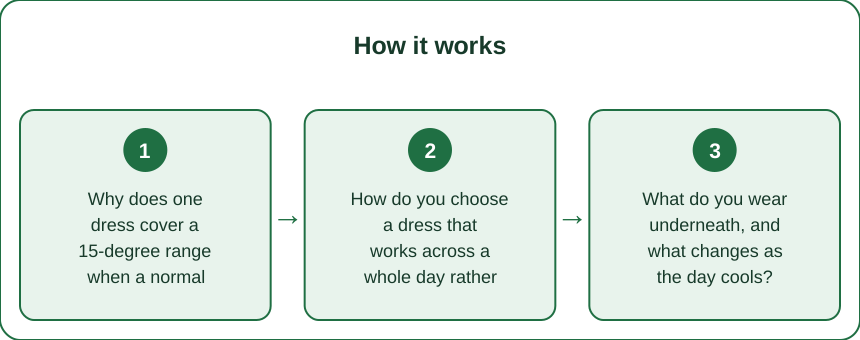
Why does one dress cover a 15-degree range when a normal outfit does not?
Because the layer you would normally change is the one part you are keeping, and everything around it is independent.
The structural advantage. A conventional outfit is a top and a bottom, and adjusting temperature usually means changing one of them - which means finding somewhere to change and carrying the replacement. A dress separates the body-covering layer from the temperature-adjusting layers entirely.
The three independent levers:
- Legwear, ranging from bare legs through to full-length leggings, which is a genuinely large thermal range on its own
- The outer layer, from nothing through to a light jacket
- Footwear, from sandals to socks and trainers, which affects perceived warmth more than people expect
Why footwear matters more than it sounds. Peripheral circulation to the feet drops as ambient temperature falls, and cold feet strongly influence overall thermal comfort. Adding socks and closed shoes can shift how warm you feel by an amount that is out of proportion to the coverage - it is one of the cheapest adjustments available.
The sequence that works, and it is not obvious:
- First, legs. As it cools, bare legs are what you notice first because the surface area is large and unprotected
- Second, feet. Closed shoes and socks
- Third, arms and torso. The outer layer, which people reach for first and which is usually the least effective of the three at the point they reach for it
What this means for what you carry. A pair of light leggings or long socks rolled small, plus one packable layer. Both fit in a small bag, which is the whole point - the alternative is carrying a complete change of clothes.
The late-August specific case. A 33C afternoon and an 18C evening is a 15-degree swing inside eight hours. That is a bigger range than most winter days produce, and it is why this season is harder to dress for than the cold months.
How do you choose a dress that works across a whole day rather than a workout?
Five checks, and one of them accounts for most complaints about exercise dresses.
1. The built-in shorts, which is the check that matters most.
- Do they ride up when you walk? Test by walking, not by standing in a fitting room. Ride-up is the single most common failure and it is entirely determined by the leg opening and the fabric grip
- Silicone grip at the hem, or a longer inseam, are the two things that solve it. A short unfinished leg opening on a smooth fabric will migrate within minutes
- Are they a separate short or bonded to the dress? Separate shorts generally move better and dry faster
2. Length, tested seated. Stand-up length tells you nothing. Sit down, cross your legs, and lean forward - that is the position that decides whether you can wear it to lunch.
3. Fabric weight and opacity.
- Hold it to the light stretched over your hand. Late summer means bright direct sun, and a light-coloured thin knit becomes transparent in ways it is not indoors
- Mid-weight fabrics travel better across a long day than very light ones, which crease and cling
4. The bra situation. Built-in shelf bras vary enormously.
- A shelf bra is adequate for walking and low-impact work and generally not for running or jumping
- If the dress has removable cups, check whether they survive a wash cycle in place. Most do not, and retrieving and reinserting them is a genuine ongoing annoyance
- Straps that can be adjusted matter more on a dress than on a top, because the whole garment’s fit hangs from them
5. Pockets, tested with an actual phone.
- A thigh pocket holding a modern large phone without swinging is rarer than the marketing suggests. Put your phone in it and walk
- Two pockets beat one, and a side pocket for keys is the difference between usable and decorative
What do you wear underneath, and what changes as the day cools?
Underneath is a comfort decision in the afternoon and a temperature decision by evening.
Afternoon, at peak heat:
- The built-in shorts alone, assuming they pass the ride-up test. Adding anything under them in 33C traps heat with no benefit
- If chafing between the thighs is a factor - and in humid late summer it is for many people - a longer, closer short or an anti-chafe balm solves it better than adding a second layer
- On the bra question in heat, a separate light sports bra under a shelf-bra dress adds support at a real cost in warmth. Worth it for anything above walking pace, not otherwise
Evening, as it drops toward 18 to 20C:
- Full-length leggings under the dress is the most versatile option and the one that changes the look least. Match the tone rather than the exact colour - an exact match rarely happens and a deliberate contrast reads better than a near-miss
- Knee-high or over-the-knee socks are a lighter alternative that packs smaller
- Bike shorts in a contrasting length if the dress is on the longer side
The transition timing. People add layers when they notice they are cold, which is roughly twenty minutes after the point at which adding them would have prevented it. Add legwear at the point the sun goes off the buildings, not at the point you feel cold - the delay is the whole problem.
On the outer layer specifically:
- An open-front layer, for the same reason as any transitional outfit - it goes on one-handed and does not disturb the dress underneath
- Length matters against a dress. A cropped layer over a mid-length dress is a clean proportion; a layer that ends within a few centimetres of the dress hem is the one awkward option
- A packable shell if there is any chance of rain, which in late summer arrives suddenly
Bags and how they sit on a dress. A crossbody strap on a light dress fabric drags the neckline sideways over a few hours. A wider strap or a small backpack distributes it better, and this is one of those things nobody mentions until it has ruined an afternoon.
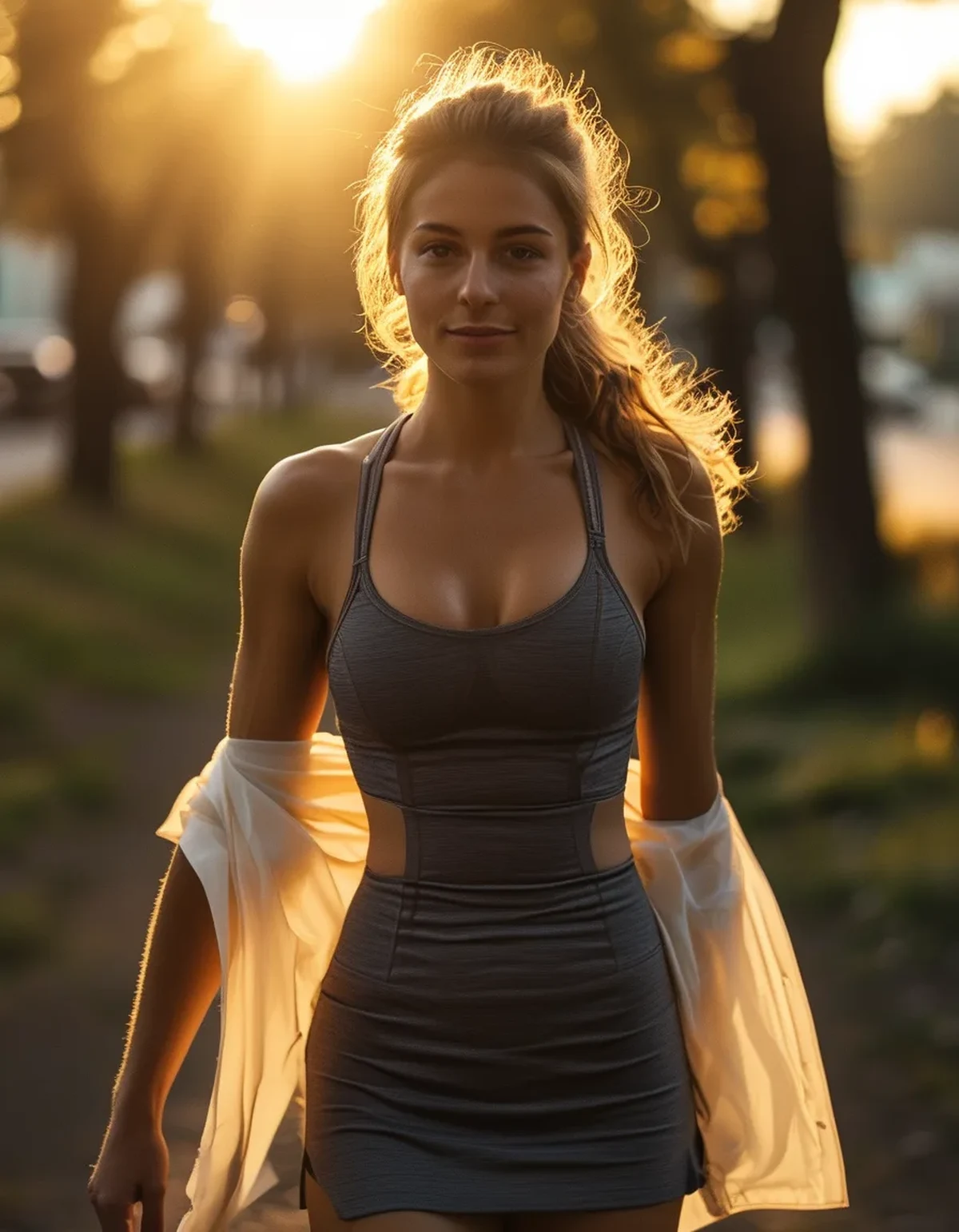
How do you take one dress from a workout to the rest of the day?
The dress usually survives the transition. The question is whether you do.
The sweat reality, stated plainly. A technical dress dries fast, but a dress that has been genuinely sweated in is not something to sit through lunch in without intervention. Planning for that is the difference between a workable system and wishful thinking.
What actually works:
- Keep the intensity appropriate to the plan. A walk, a light class, a hike at conversational pace - the dress goes straight into the rest of the day. A hard interval session in 30C humidity does not, and no fabric changes that
- Change the underlayers, not the dress. A fresh sports bra and fresh shorts, which fit in a small bag, resets most of the problem
- Ten minutes in moving air before putting the outer layer on. A technical fabric loses most of its surface moisture quickly if you do not seal it under a jacket immediately
- A quick wipe with a facecloth at the back of the neck, underarms and behind the knees does more than any product
Making it read as an outfit rather than as activewear:
- Change the shoes. This single change does most of the work. Trainers to flat sandals or a clean minimal shoe shifts the whole read
- Add one non-athletic item - a linen shirt, a leather-strap bag, a piece of jewellery. One is enough and two is better than three
- Take off anything with a visible technical function - the running belt, the visor, the fitness watch if it is a large sport model
The colour choice that makes this easier. Solid deep tones and muted neutrals cross over effortlessly. Bright colour blocking and visible logo panels read as sportswear regardless of what you add, which is fine if that is what you want and worth knowing if it is not.
What to carry, complete list. Light leggings, one open-front layer, flat shoes, a small anti-chafe stick, and a facecloth. That is a small bag, and it covers a twelve-hour day from 33C to 18C.
Myth vs Fact: Exercise Dresses in Transitional Weather
Myth: Exercise dresses are summer-only garments. Fact: They cover a wider range than most single garments precisely because everything around them is adjustable. Leggings underneath extend them well into cold weather.
Myth: The built-in shorts make a separate pair unnecessary. Fact: For low-impact activity in mild conditions, usually true. For high-impact work, long days, or serious heat, most people are more comfortable with a dedicated short underneath.
Myth: A shelf bra is enough support for any activity. Fact: A shelf bra is designed for low-impact movement. For running or jumping, a proper sports bra underneath is the difference between comfortable and not.
Myth: Matching leggings to the dress exactly looks best. Fact: An exact match almost never happens, and a near-miss is more noticeable than a deliberate contrast. Pick a clean contrasting tone instead.
Myth: Technical fabric means you can go from workout to dinner with no intervention. Fact: Fabric dries fast; that is not the same as being fresh. Changing the underlayers and allowing ten minutes of airflow is what makes it work.
Myth: Adding a jacket is the first step when it cools. Fact: Bare legs are the largest exposed area and the first thing you feel. Legs, then feet, then torso is the order that works.
FAQ: Exercise Dresses Across a Long Day, Answered
How do I stop the built-in shorts riding up?
Look for silicone grip at the leg hem or a longer inseam, and test by walking rather than standing. Ride-up is determined almost entirely by the leg opening.
Can I wear an exercise dress into autumn?
Yes. Full-length leggings underneath plus closed shoes extends the range by many degrees, and the dress itself does not change.
What do I put on first when the evening cools?
Legwear, then socks and closed shoes, then an outer layer. Bare legs are the largest exposed surface and the first thing you notice.
Do I need a sports bra under a dress with a shelf bra?
For walking and low-impact classes, usually not. For running or anything with jumping, yes - shelf bras are built for low impact.
How do I make it look less like activewear afterwards?
Change the shoes and add one non-athletic item. Those two changes do most of the work, and solid muted colours cross over far more easily than bright colour blocking.
What should I check before buying one?
Sit down in it, walk in it, put your actual phone in the pocket, and hold the fabric to the light stretched. All four failures are invisible standing still in a fitting room.
TL;DR:
- A dress covers a 15-degree day because legwear, footwear and outer layer adjust independently of it
- Add legs first, feet second, torso third - the reverse order is why people stay cold in a jacket
- Test the built-in shorts by walking, and the length by sitting; both fail invisibly while standing
- Change the underlayers rather than the dress to take a session into the rest of the day
- Solid muted tones cross from workout to dinner effortlessly; colour blocking does not
The advantage is not that the dress does everything. It is that the dress stays constant while everything around it changes.
See It in Motion
Seen here: Racerback Tank Top - White — shop similar styles on bubblelime.com
Keep Reading
This article is for general informational and styling purposes only. Fit, sizing, and product availability may vary.