Do Exercise Dress Pockets Actually Hold Up During a Workout, or Are They Just for Show?
Quick Answer: Side-seam or hip pockets with a snug, fitted opening (rather than a loose flap-style pocket) are the design most likely to keep a phone or key secure through running or high-movement exercise, while pockets positioned lower on a flared skirt hem tend to bounce and shift regardless of brand reputation.
Pocket placement relative to your hip and the tightness of the opening matter more than the pocket’s overall size.
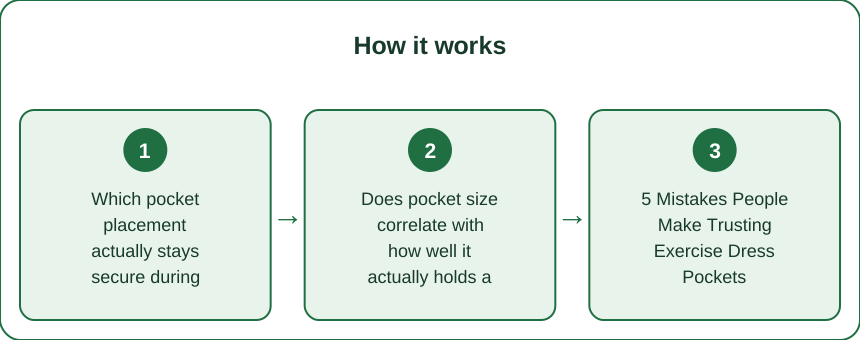
Which pocket placement actually stays secure during high-movement exercise?
Pockets sewn into the side seam at hip height, with a snug rather than loose opening, move with your body’s center of mass and experience the least bounce, which is why this placement is the most reliable for carrying a phone through running or jumping movements specifically.
Pockets set lower on a flared or tiered skirt hem swing more freely with the fabric’s movement, making them a better fit for lighter items like a key or card rather than anything heavier like a phone.
Does pocket size correlate with how well it actually holds a phone in place?
Not directly — a pocket sized exactly to a phone with minimal extra room actually holds it more securely than an oversized pocket, since excess space is what allows a phone to shift and bounce during movement, regardless of the pocket’s overall placement.
This is why some snug, minimalist pockets that look almost too small in product photos end up performing better in practice than a roomier-looking pocket on a similar dress.
5 Mistakes People Make Trusting Exercise Dress Pockets
Mistake 1: Assuming any built-in pocket is tested for running specifically, when some are designed more for casual wear.
Mistake 2: Loading a pocket with a phone plus keys and cards simultaneously, which adds weight the pocket wasn’t necessarily built to secure.
Mistake 3: Not test-jogging in place before buying to feel actual bounce.
Mistake 4: Choosing based on photos alone without checking reviews for pocket-specific complaints.
Mistake 5: Ignoring pocket depth, which matters as much as width for keeping a phone from working its way out.
Is there a workaround for dresses with pockets that don’t hold up well on their own?
Pairing a dress with built-in compression shorts or a liner that has its own more secure pocket is a common workaround, using the dress’s pocket for lighter items and the liner’s pocket for a phone specifically.
Some runners also simply choose to carry a phone in an arm band or waist belt regardless of what the dress offers, treating the dress pocket as a bonus for smaller items rather than the primary phone-carrying solution.
FAQ: Exercise Dress Pocket Questions, Answered
Are zippered pockets better than open pockets for security?
Yes, generally — a zipper adds a meaningful layer of security against an item working its way out during high-movement exercise, though it adds a small amount of bulk.
Do exercise dress pockets typically fit larger phone models?
This varies significantly by brand and dress, so checking specific phone-size compatibility in reviews is worth doing before assuming a larger phone will fit.
Does washing affect how well a pocket holds its shape over time?
Repeated washing can loosen pocket elastic or seams over time, so a pocket that fit snugly when new may loosen somewhat after months of regular wash cycles.
TL;DR:
- Side-seam, hip-height pockets with a snug opening are the most secure design for running specifically
- A pocket sized close to your phone (not oversized) holds it more securely than a roomier one
- Loading multiple items at once, and skipping a test jog before buying, are the most common mistakes
- Zippered pockets or a separate liner pocket are reliable workarounds when a dress’s built-in pocket falls short
Pocket placement and fit matter far more than the marketing photos suggest — check both before trusting one with your phone.
Keep Reading
This article is for general informational and styling purposes only. Fit, sizing, and product availability may vary.