How to Wear an Exercise Dress Into Autumn Without Buying Anything New
Quick Answer: An exercise dress transitions to autumn with three additions you almost certainly already own: something on the legs, something with sleeves, and closed shoes. Bare legs work to around 18C, opaque tights or leggings underneath extend it to around 8C, and adding a long-sleeve base layer beneath the dress plus a knit over it takes it into genuine cold. The order matters - base layer under, knit over, legs covered - because layering the dress on the outside is what makes it look like a dress rather than gym kit with additions.
You wore it constantly from May. It is mid-August, mornings have started arriving cool, and there is a real temptation to fold it away for eight months. That would be a waste - the exercise dress is one of the most extendable garments in the wardrobe, and the extension costs nothing.

Why does an exercise dress transition well at all?
Because of what it actually is, structurally.
It is a base layer with a skirt. Most exercise dresses are a fitted, moisture-wicking bodice - often with a built-in bra or liner shorts - and a skirt over the top. That bodice is functionally identical to a technical base layer, which means it does what a base layer does when you put things over it: manage moisture, sit close to the skin, and not add bulk.
The skirt solves the layering problem that leggings have. When you layer over leggings, everything reads as gym. When you layer over a dress, everything reads as an outfit, because a skirt hem below a jacket hem is a normal thing that normal clothes do. This is the whole reason the transition works, and it is why the same layers over the same body in leggings look completely different.
The built-in liner shorts are the underrated part. They mean you can put leggings or tights underneath without any of the awkwardness of layering over bare skin, and they eliminate the ride-up problem that makes some dresses unwearable in wind.
The fabric handles temperature swings well. Technical knits with elastane are usually thin, quick-drying, and comfortable across a wide range because they move moisture rather than holding it. That is exactly the property you want in a season where you are outside in 12C at 8am and 24C at 3pm.
The limit is wind and wet. Technical knit provides essentially no wind resistance and holds no warmth once damp. Which is why the outer layer in the transition system is doing the real work once the temperature drops - the dress is the base, not the insulation.
The temperature ladder, in five steps
Work down the ladder as the season moves. Each step adds one thing.
Above 20C - the dress as it is. Bare legs, the same trainers you have been wearing, maybe sunglasses. This will still happen on plenty of September afternoons.
16 to 20C - add sleeves and closed shoes. A light long-sleeve knit, a denim jacket, a cropped overshirt, or an unbuttoned shirt worn open over the top. Swap sandals or slides for a trainer or a flat leather-look shoe. Bare legs are entirely comfortable in this range while moving.
11 to 15C - add legs. Full-length leggings under the dress in a matching or contrasting dark tone, or opaque tights if you want the more polished version. Keep the sleeve layer. This is the configuration that carries most of October in most of the country and it is genuinely comfortable.
6 to 10C - add a base layer under the dress. A thin long-sleeve technical top underneath the dress bodice, plus leggings, plus a proper knit or fleece over the top. Ankle boots or a warm trainer. The under-layer is the step people skip, and it is the one that makes the difference between wearable and grim.
Below 6C - add insulation and wind resistance on the outside. A vest or a light insulated jacket over everything, a longer sock, and gloves if you are outdoors for a while. At this point the dress is functioning purely as a mid-layer with a skirt, which is a legitimate and comfortable thing for it to be.
One rule that holds at every step: anything sleeved goes over the dress, anything thin and fitted goes under it. Reversing that is what produces the bunched, lumpy look people blame on the dress.
What Nobody Tells You About Layering a Dress
Hem lengths need to disagree. If your jacket hem and dress hem land within a couple of inches of each other, the whole thing reads as one confused garment. Either significantly shorter - a cropped jacket ending at the waist - or significantly longer - a cardigan past the dress hem. The middle ground is the only genuinely bad option.
The under-layer sleeve should be visible and deliberate. When you wear a thin long-sleeve under the dress, the sleeves showing at the shoulder and wrist look intentional in a contrasting colour and look like an accident in a slightly-off matching one. Go clearly different - black under a cream dress, cream under a navy one - rather than nearly the same.
Tights change the register more than leggings do. Opaque tights under an exercise dress read as a normal autumn outfit. Athletic leggings under the same dress read as athletic. Neither is wrong; they are two different outfits and it is worth knowing which one you are producing.
Socks are visible now, so they are part of it. With ankle boots or trainers, a crew sock in a colour that relates to something else in the outfit does real work. This is genuinely one of the highest-return, lowest-cost details in autumn dressing.
The pocket problem gets worse in autumn. In summer you carried nothing. In autumn you have a phone, keys, and possibly gloves, and most exercise dresses have shallow or no pockets. The layer over the top needs pockets, or you need a crossbody - decide before you leave, not at the door.
And the wind test is real. A skirt that behaved perfectly all summer behaves differently in an October gust. If yours is light, the leggings-underneath step is not optional past a certain point.
Three outfits, fully specified
The September afternoon. Exercise dress, bare legs, white trainers with a low crew sock, denim jacket, small crossbody, sunglasses. Works for a walk, a coffee, a school run, and a garden centre. If it warms up, the jacket goes in the bag. Total additions to your summer version: a jacket and a sock.
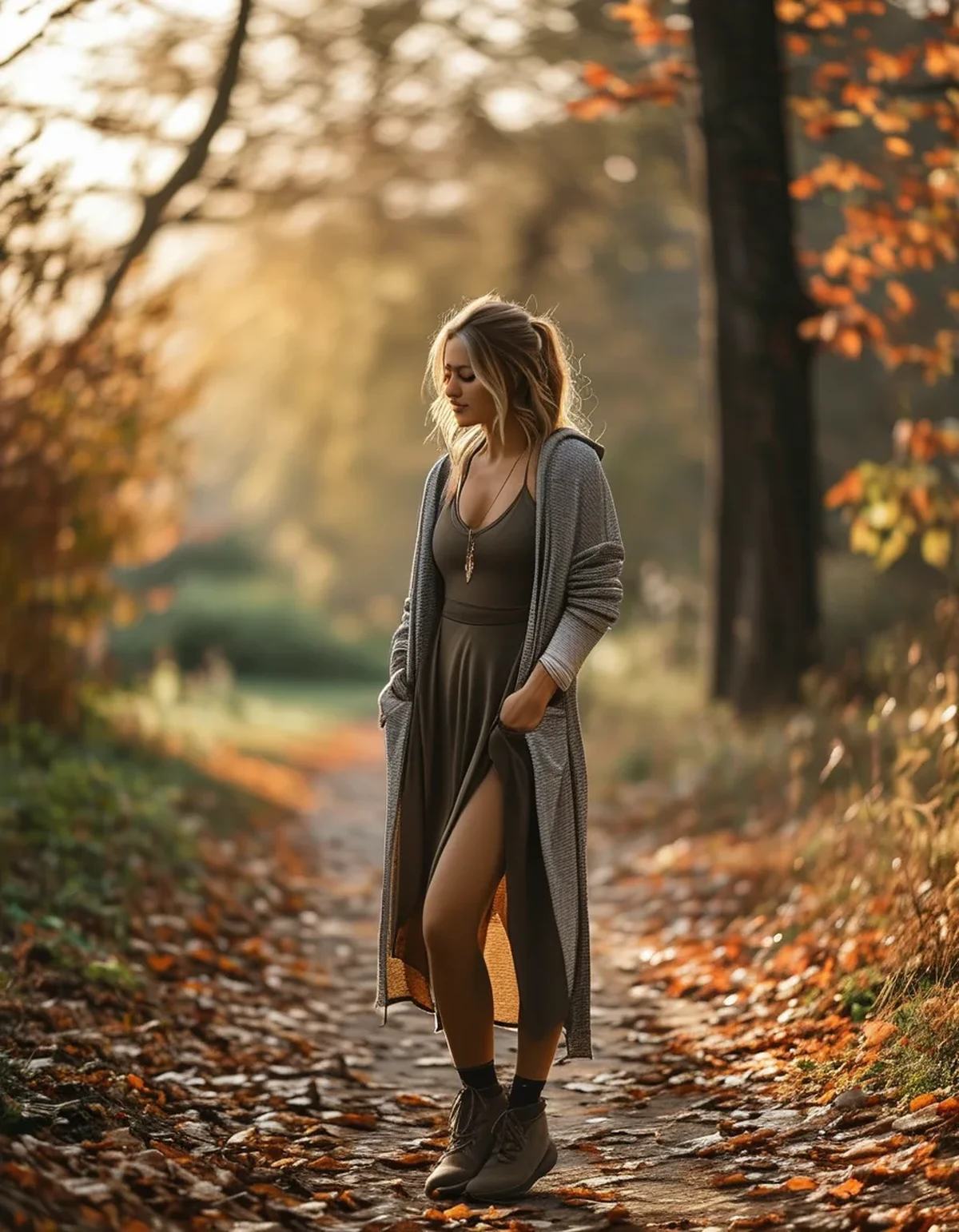
The October standard. Exercise dress, full-length black leggings underneath, ankle boots, a chunky cardigan long enough to sit past the dress hem, and a scarf if the morning is sharp. This is the workhorse and it will get worn twice a week. The long cardigan is doing the heavy lifting - it changes the proportion and provides the pockets.
The cold morning walk. Thin long-sleeve technical base layer under the dress in a contrasting colour with the sleeves showing, dress over it, fleece leggings or thermal tights underneath, a light insulated vest or jacket on top, warm trainers with a full sock, gloves. This is genuinely comfortable down to near freezing while moving, and it packs down small enough that shedding the vest at the halfway point is easy.
A note on what to buy if you were going to buy anything: the highest-value single addition is a thin technical long-sleeve base layer in a colour you like showing. It costs less than a dress, and it is the item that extends the whole system by about eight degrees. Second most valuable is a long cardigan with real pockets.
And what not to bother with: a dedicated autumn exercise dress. You have one. It has always worked in this temperature range - the layers around it were the missing part.
How does it hold up across a whole autumn day?
Autumn days have a much wider temperature range than summer ones, and the dress handles that better than almost anything else in the wardrobe - provided you plan the shedding order.
The morning-to-afternoon swing is the real test. A September day across most of the northern US routinely runs from 11C at 8am to 24C at 3pm. That is a 13-degree spread inside a single outfit, considerably wider than any July day produces. The dress system absorbs it because every layer is removable and none of them are structural - take off the cardigan, push the base layer sleeves up, and you have moved down two rungs of the ladder without changing anything that matters.
Decide the shed order before you leave the house. Outer layer first, then sleeves pushed up, then the leg layer last since that is the one you cannot remove discreetly. Knowing the sequence in advance is the difference between adjusting comfortably and carrying an armful of clothing for three hours.
The dress itself never becomes the wrong garment. This is what separates it from a jumper-and-jeans outfit, where the core item is exactly the thing that turns wrong at 2pm. The dress bodice sits at the same comfort level across the entire range because it is a technical base layer doing what technical base layers do.
Moisture management matters more in autumn, not less. It is easy to assume wicking is a summer concern. In practice, cool weather with layers produces the most common comfort failure there is - you overheat walking uphill, sweat into a base layer, then stop moving and get cold fast as that moisture evaporates off your skin. A technical dress bodice moves that moisture outward instead of holding it, which is exactly why this works better than a cotton dress with identical layers over it.
Wind is the variable to respect. Technical knit provides essentially no wind resistance, and 15mph of wind at 12C feels dramatically colder than still air at the same temperature. If there is wind in the forecast, the outer layer needs to be windproof rather than merely warm - a thin shell beats a thick knit on a windy day, every single time.
And rain is the honest limit. Once a technical knit is wet it retains no warmth at all, and a soaked skirt is unpleasant in a specific and memorable way. If rain is likely, either your outer layer is genuinely waterproof and long enough to cover the dress hem, or this is a day for something else entirely. Every system has an edge, and this is where this one sits.
FAQ: Exercise Dress Autumn Questions, Answered
Can you wear an exercise dress in autumn?
Yes, comfortably into genuinely cold weather with the right layers. Bare legs work to around 18C, leggings or opaque tights underneath extend it to around 8C, and a thin base layer under the dress plus a knit over it takes it below that. The dress becomes a mid-layer rather than the whole outfit.
What do you wear under an exercise dress when it gets cold?
Full-length leggings or opaque tights on the legs and, once it is properly cold, a thin long-sleeve technical top under the dress bodice. Pick a clearly contrasting colour for the under-layer so the sleeves at the wrist and shoulder read as deliberate rather than accidental.
What shoes go with an exercise dress in autumn?
Closed shoes with a visible sock - a clean trainer or a flat ankle boot. Both work, and the sock is a genuine styling element rather than an afterthought. Ankle boots shift the outfit further from athletic; trainers keep it casual and comfortable for distance.
How do you layer over an exercise dress without it looking bulky?
Keep the hem lengths clearly different - a cropped jacket ending at the waist, or a cardigan running past the dress hem. Anything landing within a couple of inches of the dress hem creates a muddled line. And keep thin fitted layers underneath, structured layers on top.
TL;DR:
- Bare legs to 18C, leggings underneath to 8C, base layer under the dress below that.
- Thin and fitted goes under the dress; sleeved and structured goes over it.
- Hem lengths should clearly disagree - cropped at the waist or long past the dress.
- Socks are visible in autumn and are worth choosing on purpose.
- The one thing worth buying is a thin contrasting long-sleeve base layer.
It was never a summer garment. It was a base layer with a skirt that happened to be enough on its own for four months.
See It in Motion
Seen here: Super High Waist Embossed Yoga Leggings with Inner Pocket — shop it on bubblelime.com
Keep Reading
This article is for general informational and styling purposes only. Fit, sizing, and product availability may vary.