The Complete Guide to Exercise Dresses in Late Summer and Early Fall
Quick Answer: Late summer is the exercise dress’s best season and its hardest one. Heat favors the dress’s airflow advantage, while the coming temperature swings expose its main weakness — it does not layer well from the bottom. Choose by fabric weight for the activity, check the built-in short length against your actual thigh contact, and plan the layering strategy before the weather turns, because a dress that works in August needs a plan by late September.
The exercise dress is the single best garment for a humid 88-degree morning and the single most awkward one for a 61-degree evening.
Both of those happen this month. Here is the whole framework.
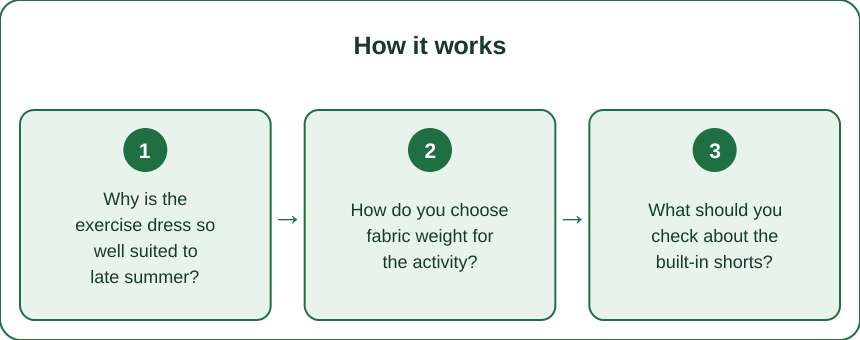
Why is the exercise dress so well suited to late summer?
Because its structural advantage is airflow, and airflow is what matters most in heat.
A dress does not have a waistband. That single fact changes a lot. Waistbands compress at exactly the point where heat and sweat accumulate, and they are where most people’s hot-weather discomfort originates. A dress hangs from the shoulders, leaving the entire torso-to-thigh region open to moving air.
It also has no fabric-on-fabric contact at the hip and thigh. Leggings and shorts both create a layer against the skin that traps warmth and moisture. A dress skirt moves independently, which allows air exchange with every step.
And it eliminates the top-to-bottom transition entirely — no riding-up top, no rolling waistband, no gap. In humid weather, where sweat is not evaporating well, those contact points are where chafing and irritation start.
Where the advantage is largest: walking, hiking, golf, tennis, pickleball, casual cycling, and any moderate-intensity outdoor activity in heat. Where it is smaller: anything with heavy ground contact or inversion — floor work, yoga with inversions, heavy lifting — where the skirt becomes a coverage management problem rather than an asset.
The practical summary: the hotter and more humid it is, and the more upright the activity, the better the exercise dress performs relative to the alternatives. In late August, that describes most of what people do outdoors.
How do you choose fabric weight for the activity?
This is the specification that determines whether a dress works, and it is the one most listings do not state.
Lightweight, roughly 120 to 160 GSM. Very breathable, dries fast, moves a lot in wind. Best for: hot weather walking, golf, casual wear, travel. The tradeoff is that light fabric is more prone to riding up on a windy day and more likely to be semi-sheer, which matters for the skirt specifically.
Midweight, roughly 170 to 220 GSM. The most versatile band and where most quality exercise dresses sit. Enough body to hang properly and stay opaque, still breathable. Best for: tennis, pickleball, hiking, general training, and anything where you want one dress to do several jobs.
Heavier, above about 230 GSM. More structure, more opacity, more warmth. Best for: cooler weather, early fall, and anyone who wants the skirt to stay put reliably. Too warm for peak heat.
The composition question: polyester blends dry fastest and hold printed color well, which is why most exercise dresses use them. Nylon blends feel softer and are more durable against abrasion but cost more. For a garment worn in heavy sweat, the faster-drying option is usually the better one.
Check for a stated UPF rating if you will be outdoors for hours. Golf, tennis, and hiking all involve extended sun exposure on the shoulders and upper back, and a rated fabric is a meaningful advantage over an unrated one.
The single test that predicts most disappointment: hold the skirt fabric up to a bright window and stretch it slightly. If light passes through clearly, it will be sheer in bright outdoor light, which is exactly where you will wear it.
What should you check about the built-in shorts?
The built-in short is where exercise dresses succeed or fail, and it is almost never described adequately in a listing.
Length relative to your thigh, not in inches. The number that matters is whether the short extends past the point where your thighs make contact during movement. A 4-inch short is generous on one person and inadequate on another, and inseam measurements are close to useless for predicting this. The test: walk briskly for five minutes and see whether the hem has migrated upward or whether there is any friction at the inner thigh.
Grip versus compression. Two approaches exist. Compression shorts stay put through fit, which works well but can feel restrictive in heat. Lighter shorts with a silicone gripper stay put through the gripper, which is cooler but can roll or slip when saturated with sweat. In late summer humidity, grippers are more likely to fail — worth knowing if your dress rides up specifically on hot days.
Attached versus separate. Attached shorts (sewn into the dress) cannot shift independently and are easier to manage. Separate liner shorts are more comfortable for some people and allow a different fit, but add a layer.
Pockets in the shorts are the most useful pockets on the garment. Skirt pockets sway and drop things; thigh pockets in the built-in short hold a phone securely through movement. If you carry a phone, this is the single most important feature to check.
Check the fabric of the short separately from the dress. Manufacturers often use a heavier, less breathable fabric for the liner, which undermines the dress’s whole airflow advantage. A breathable outer with a hot compressive liner is a common and frustrating combination.
How do you handle coverage and wind confidently?
Coverage anxiety is the most common reason people buy an exercise dress and then do not wear it, and most of it is solvable.
Skirt length is the primary variable. Longer skirts move more in wind but cover more when they do. Shorter skirts move less overall. The most manageable range for windy or active use is a mid-thigh skirt with a well-fitted built-in short — the short becomes the actual coverage and the skirt becomes styling.
The relationship that matters: the skirt should be long enough that the built-in short is not visible in normal standing and walking, but you should be entirely comfortable if it becomes visible. If you would be uncomfortable with the short showing, the dress will make you anxious for its whole life, regardless of how well it fits.
Fabric weight controls wind behavior more than length does. A midweight skirt is dramatically more stable in wind than a very light one, and this is the fix people rarely consider. If wind is your concern, go one weight heavier rather than one length longer.
Some dresses include a small weighted hem or a slightly A-line cut that resists lifting. Both work.
For bending and reaching — golf, gardening, picking things up — the built-in short is doing all the work, so its length and its coverage at the back is what to check. Test by bending forward fully in front of a mirror before removing the tags.
On sitting: a skirt with enough fabric to gather comfortably is easier than a narrow one that pulls. This is the situation where a slightly fuller cut clearly outperforms a fitted one.
The honest note: if you spend the whole activity managing the skirt, the dress is wrong for that activity, not for you. Different dresses suit different uses, and one dress genuinely does not cover everything.
How do you layer an exercise dress into fall?
This is the section that matters most right now, because the answer needs deciding before the weather changes rather than after.
The core problem: a dress does not layer downward well. You can add to the top half easily; the bottom half has fewer good options, and the wrong one ruins the whole silhouette.
What works on the bottom:
- Full-length leggings underneath, matched in color to the dress or to the built-in short. This is the best option by a clear margin and extends an exercise dress well into cool weather.
- Knee-length compression shorts for a modest temperature drop, which keep the leg line clean.
- Tall socks for hiking or trail use, which cover the calf without adding a full layer.
What does not work: cropped leggings that end mid-calf, which create an awkward break; contrasting colors that draw the eye to the layering; and anything bulky, which defeats the dress’s fit.
What works on top:
- A long-sleeve base layer under the dress, which is the cleanest solution and preserves the silhouette entirely.
- A light quarter-zip or shell over the dress, ending above the skirt hem.
- A cropped jacket, which works well because it does not compete with the skirt line.
What does not work on top: anything hip-length or longer, which covers the skirt and makes the dress read as a top with a strange hem.
The seasonal timeline from here: the dress alone works through most of September in much of the US. Add a long-sleeve base layer for October mornings, add leggings underneath for November, and by December it is generally a summer garment again unless you run warm.
Buy the leggings now if you plan to layer. Matching a legging to a dress you already own is far easier than the reverse, and the colors you want will be easier to find while summer stock is still available.
What Nobody Tells You About Exercise Dresses
The built-in short is the garment. The dress is the part everyone evaluates and the short is the part that determines whether you wear it twice or two hundred times. Evaluate accordingly.
They are far better for travel than they look. One garment replaces two, they pack small, they dry overnight in a hotel bathroom, and they work for both activity and dinner. This is arguably their strongest use case and it is rarely the one advertised.
Sizing runs differently from leggings, and between-size shoppers should generally size up. The shoulder-to-hip fit has to work across a wider range of body shapes than a legging does, and a dress that is slightly tight through the hip will ride up constantly.
Sports bra compatibility is a real consideration. Some dress necklines and back designs conflict with certain bra straps, and racerback dresses in particular limit your options. Check what you actually own before buying.
A dress with a built-in bra is convenient and usually offers less support than a proper sports bra. For low-impact activity it is fine. For running or high-impact work, most people need a separate bra, and a dress with a built-in shelf underneath a real bra is uncomfortable.
Wash them like performance fabric, because that is what they are. Cold water, no fabric softener, line dry. The built-in short’s gripper elastic in particular degrades quickly in a dryer, and gripper failure is what makes an older dress start riding up.
Skirt pockets are mostly decorative. They sway, they drop phones, and they pull the fabric out of line when loaded. Thigh pockets in the built-in short are the functional ones.
They are more polarizing to wear than they are to look at. Many people feel self-conscious for the first two or three wears and then stop thinking about it entirely. If you are on the fence, that adjustment period is worth budgeting for rather than judging the garment on the first outing.
FAQ: Exercise Dress Questions, Answered
Can you run in an exercise dress?
Yes, though it depends on the dress. Look for midweight fabric, a compression-style built-in short rather than a gripper one, and a skirt short enough not to move excessively. Also plan for a separate sports bra rather than relying on a built-in shelf.
What size should I buy?
If you are between sizes, size up. Dresses need room through the hip to hang correctly, and a tight hip means constant riding up.
Are they good for hot yoga or floor work?
Generally no. Inversions and floor positions make skirt management a constant distraction, and the coverage requirements are different from upright activity.
How do I stop it riding up when I walk?
Usually the built-in short is too short for your thigh contact point, or the gripper has degraded from dryer heat. Check the short length against your actual walking contact, and wash and dry it as performance fabric.
Can I wear one into fall?
Yes, well into it. Add a long-sleeve base layer underneath for cool mornings and full-length matched leggings underneath when it gets genuinely cold. Buy the leggings now while colors are easy to match.
What is the best fabric weight for one all-purpose dress?
Midweight, roughly 170 to 220 GSM. It is opaque, hangs properly, stays stable in wind, and is still breathable enough for hot weather — the widest useful range from a single garment.
TL;DR: The exercise dress is at its best in late summer and needs a layering plan before fall.
- Its advantage is airflow — no waistband, no fabric-on-fabric at the hip, no top-to-bottom transition. Best in heat and in upright activities.
- Fabric weight decides everything: midweight, 170 to 220 GSM, is the most versatile and the most wind-stable.
- The built-in short is the real garment. Check length against your actual thigh contact, check whether it has thigh pockets, and check its fabric separately from the dress.
- For wind, go one weight heavier rather than one length longer.
- Layer with full-length matched leggings underneath and a cropped layer on top. Cropped leggings and hip-length jackets both ruin the line.
- Buy the layering leggings now, while matching colors are still in stock.
- Wash cold and line dry — dryer heat kills the gripper elastic, and that is what makes an older dress ride up.
Check the built-in short before anything else. It decides whether the dress gets worn.
See It in Motion
Seen here: Racerback Tank Top - White — shop similar styles on bubblelime.com
Keep Reading
This article is for general informational and styling purposes only. Fit, sizing, and product availability may vary.