The Complete Guide to Wearing an Exercise Dress Into Early Fall
Quick Answer: An exercise dress works into the 50s with the right layering, which extends its season by roughly two months rather than ending it with summer. The three-part system: a fitted long-sleeve base underneath, opaque tights or a legging for the legs, and a structured light layer on top. The two failure points are proportion - the dress hem against the layer hem - and the built-in short, which changes how anything worn underneath fits.
It is the single most convenient thing in your drawer and you are about to stop wearing it for eight months over a fifteen-degree temperature change.

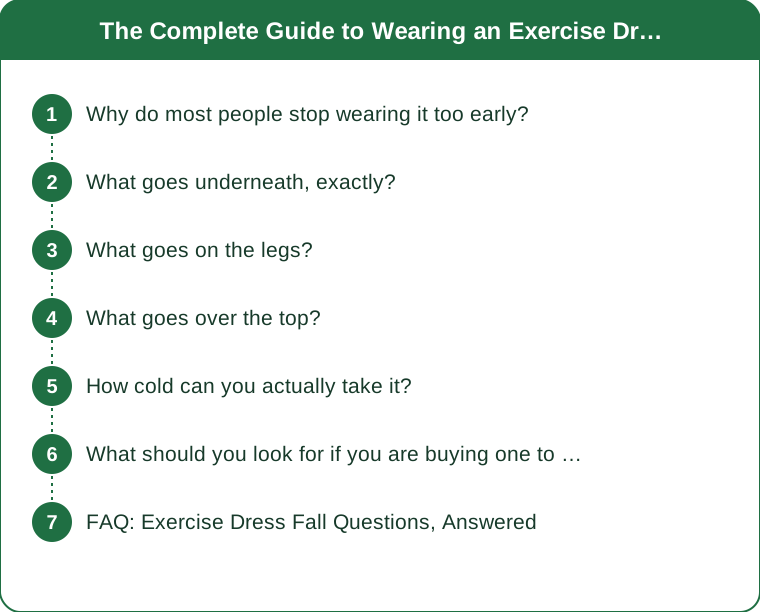
Why do most people stop wearing it too early?
Not because of the temperature, but because the first attempt at layering looks wrong and they conclude it cannot be done.
The obvious layering attempt fails. A regular long-sleeve top under a dress bunches at the shoulders and armholes, particularly with the built-in bra most exercise dresses have. It looks and feels bulky, and one bad attempt reads as proof.
The proportions get confusing. A jacket hem that lands close to the dress hem creates a visual line that reads as awkward rather than intentional. This is the most common styling failure and the easiest to fix once you know what to look for.
Bare legs feel wrong before they are actually cold. In the 60s, bare legs are perfectly comfortable while walking, but they read as summer, and the seasonal mismatch is what makes people reach for something else.
And the built-in short complicates everything. Most exercise dresses have integrated shorts, which means anything worn on the legs has to work with them rather than replace them - a genuine fit question that nobody addresses when explaining how to layer a dress.
The result: a garment with real utility gets shelved in early September for reasons that are all solvable in about ten minutes of experimenting.
What goes underneath, exactly?
The base layer is where the whole system succeeds or fails.
A seamless or very thin fitted long-sleeve. Not a regular cotton tee with sleeves - the bulk at the armhole is what ruins it. Seamless construction, thin technical knit, or a lightweight merino base layer all sit flat under the dress and add real warmth.
Match or contrast deliberately. A base in the same color as the dress reads as one garment and is the safest option. A deliberate contrast - black base under a colored dress - reads as intentional and is the more interesting choice. What looks accidental is a near-match that is slightly off.
Mind the neckline. A crew neck base under a scoop or V-neck dress shows the base at the chest, which looks fine if it looks deliberate. A high neck under a high neck is bulky and warm in the wrong place.
Check the built-in bra. Some exercise dresses have a shelf bra that sits directly against the skin. Wearing a base layer underneath it changes the support slightly, so try it before relying on it for a run. Wearing the base over the built-in support and under the dress is usually more comfortable, though it takes a moment to get right.
Sleeve length matters at the wrist. A base sleeve that ends mid-forearm looks unfinished under a sleeveless dress. Full length to the wrist, or thumbholes, reads as deliberate.
What goes on the legs?
Three options, and the built-in short determines how each behaves.
Opaque tights. The most seasonally correct choice, and the one that most changes how the dress reads - it moves from summer to autumn immediately. Choose 60 denier or heavier for opacity and warmth; anything sheerer reads as hosiery rather than activewear.
A full-length legging. The most practical option for actual exercise. Match the color to the dress or go black, and check the waistband against the dress’s built-in short - two waistbands at slightly different heights can create a visible ridge under a fitted dress.
A 7/8 or capri legging. Better in the transition weeks when full length is too warm in the afternoon. The exposed ankle keeps it from reading as full winter.
On the built-in short: wear the legging over the built-in short, not instead of it, unless the dress has a removable liner. Two layers at the hip is normally fine because both are thin, but if the built-in short is a compression fit, size up the legging or choose a lighter-weight one to avoid a tight band at the thigh.
And check the hem relationship. The dress hem should sit clearly above where the legging ends - a legging hem and dress hem landing within an inch or two of each other looks unresolved. This is the same proportion rule as the jacket, applied downward.

What goes over the top?
Where most of the visual work happens, and where the proportion rule matters most.
The rule: the layer hem and the dress hem should be clearly different lengths. Either the layer is noticeably shorter - a cropped jacket ending at the waist or high hip - or noticeably longer - a longline coat well past the dress hem. The failure zone is a layer ending within about two inches of the dress hem, which reads as an accident.
A cropped zip jacket is the safest choice. It ends high, defines the waist, and lets the dress do the work below it. This is the default for a reason.
A structured light jacket in a clean cut works well and adds a non-athletic element that makes the whole outfit read as everyday clothing rather than gym clothing.
A longline cardigan or duster is the polished version. It must hang open and straight; anything that adds volume at the hip fights the dress’s shape.
A vest is underrated here. It adds core warmth without sleeves competing with the base layer sleeves, and it keeps the arms clean - which matters when you are already wearing two layers on top.
What does not work: a hip-length sweatshirt (wrong length, wrong volume), anything oversized (the dress’s shape disappears), and heavy knitwear (bulk at the shoulder over a base layer plus a dress is three layers at the same point).
How cold can you actually take it?
Further than most people assume, with the honest limits stated.
Into the 60s: dress alone. Bare legs, no base layer. Nothing needed.
Mid 50s to low 60s: dress plus one element. Either a base layer or tights, not usually both. This is most of September in a lot of places.
Upper 40s to mid 50s: the full system. Base layer, tights or legging, light jacket. This is genuinely comfortable for walking, errands, and moderate activity, and it is where the system earns its keep.
Low 40s and below: it depends on activity. For a run or a brisk walk it still works, because you generate substantial heat. For standing around outdoors it does not, regardless of layers - the dress’s open hem means air moves through in a way trousers do not.
Wind is the real limit, not temperature. A calm 45-degree day is fine; a windy 55-degree day is not, because air moves up under the hem. A slightly longer dress or a wind-resistant outer layer extends this considerably.
And rain ends it. A wet hem against tights is genuinely unpleasant and stays that way. This is a dry-weather system.
Shoes complete it: a sneaker works for everything above, and an ankle boot with tights turns the same dress into something you would wear to lunch.
What should you look for if you are buying one to layer?
Not every exercise dress layers well, and the differences are visible in a product photo if you know where to look.
Fabric weight in the 200 to 260 gsm range. Too light and it clings to whatever base layer you put underneath, showing every seam and creating static. Too heavy and it does not drape over a second layer at all. Mid-weight fabric with a slightly matte finish is the most forgiving over a base layer, because it skims rather than grips.
A removable or short liner. Dresses with a built-in short that ends well up the thigh layer far better over tights and leggings than ones with a longer, compressive liner. If the liner is removable, you have both options - which is worth paying a little more for if layering is the plan.
Sleeveless with a wide-enough armhole. A narrow, high armhole leaves no room for a base layer sleeve underneath and bunches immediately. A slightly relaxed armhole is the single most important construction detail for winter layering, and it is easy to see in a photo.
A hem at mid-thigh or slightly below. This is the length that gives you the most options above and below - room for a cropped jacket well above it and a legging hem well below it. Very short dresses force the jacket decision; very long ones fight the leg layer.
Pockets that work through a layer. Side or thigh pockets remain accessible with a jacket on. A back pocket does not, and neither does a chest pocket under a zip layer.
And check the neckline against what you own. A scoop or V-neck accommodates almost any base layer neckline underneath and looks deliberate. A high mock neck limits you to one option and adds bulk exactly where two layers already meet. If you own one dress and want it to work for two more months, the neckline is the constraint you will run into first.
FAQ: Exercise Dress Fall Questions, Answered
Does layering ruin the built-in bra support?
It can if you put a base layer between the bra and your body. Wearing the base over the built-in support keeps the support intact and is more comfortable for most people. For running specifically, test it on a short session before a long one.
Can I wear the same dress for a workout and afterward?
That is the main argument for owning one. Swap the jacket, add boots instead of sneakers, and it goes from a walk to a coffee without a change. The one limit is sweat - a dress worn for a hard session should be changed like any other garment.
What length dress works best for layering?
Something landing mid-thigh gives the most flexibility, because it leaves room for a clearly different jacket length above and a legging hem well below. Very short dresses limit the leg options; very long ones limit the jacket ones.
Are tights or leggings better?
Tights read more seasonally polished and are warmer for the thickness; leggings are better for actual exercise and more durable. If you are buying one for this purpose, a matte black opaque legging is the more versatile choice.
Is it worth buying a fall-specific exercise dress?
Usually not. A summer dress plus a base layer covers the same range for a fraction of the cost. Long-sleeved exercise dresses exist and are pleasant, but they are less versatile than the layered version because you cannot remove the sleeves.
TL;DR:
- The exercise dress works into the upper 40s with layering, which is roughly two extra months of use.
- Base layer: seamless or very thin fitted long-sleeve, worn over the built-in support, full length to the wrist.
- Legs: opaque tights at 60 denier or heavier, or a legging worn over the built-in short - and keep the hems clearly different lengths.
- Top layer: cropped or longline, never ending within two inches of the dress hem. That single rule fixes most of what looks wrong.
- Wind is the real limit rather than temperature, and rain ends it entirely.
The piece gets abandoned every September not because it stops working but because the first layering attempt looks off and nobody troubleshoots it. Three specific choices - a thin base, opaque legs, and a layer at a deliberately different length - keep the most convenient garment you own in rotation while the weather is still worth going outside for.
See It in Motion
Seen here: Super High Waist Embossed Yoga Leggings with Inner Pocket — shop it on bubblelime.com
Keep Reading
This article is for general informational and styling purposes only. Fit, sizing, and product availability may vary.