The Complete Guide to What Wears Out First on an Exercise Dress
Quick Answer: An exercise dress does not wear out evenly — it fails one component at a time, and almost always in the same order. The built-in liner shorts go first (typically 40 to 60 wears), then the underarm fabric, then the hem, then the shelf bra elastic, and the outer shell usually outlives all of them. Knowing the sequence means you can extend the life of the whole garment by protecting the parts that fail early, which are also the cheapest to protect.
People replace exercise dresses long before the fabric is finished, because one component fails and the whole garment feels done.
That is a genuine waste, and it is avoidable once you know which part is actually failing and why. The outer fabric — the expensive, visible, structural part — is almost never the problem.
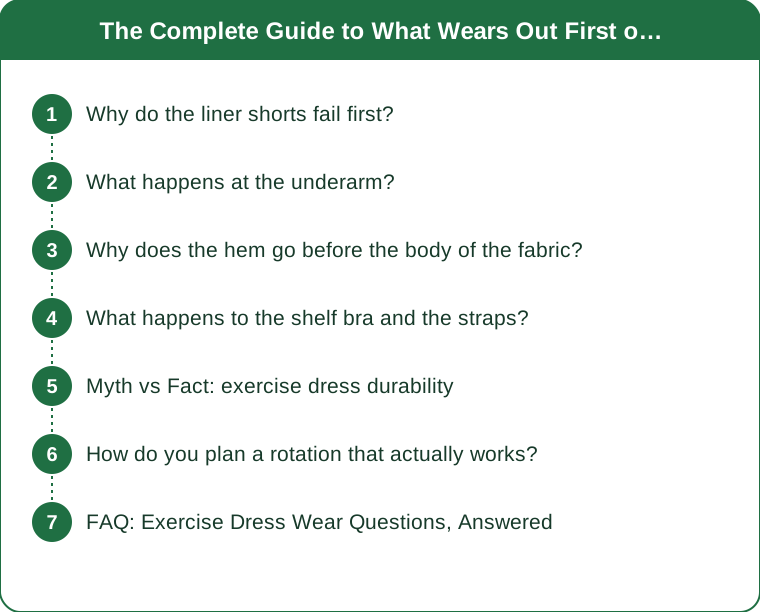
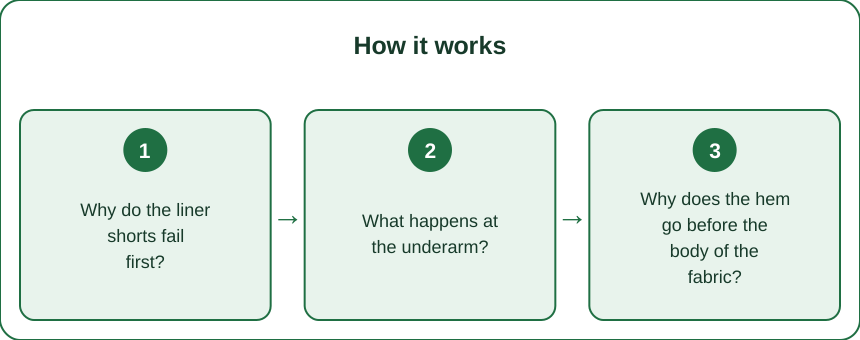
Why do the liner shorts fail first?
Because they take a combination of loads that no other part of the garment sees.
The built-in shorts sit against skin, in the warmest and dampest area of the garment, under constant stretch, with fabric-on-fabric friction on every step. Every one of those is an accelerant on its own.
Friction at the inner thigh is the primary mechanical failure. Two surfaces rubbing against each other under compression abrade both. On a dress worn for walking or running, the inner thigh sees tens of thousands of rubbing cycles per session. This is why the thinning is symmetrical and always in the same place, and why it appears long before anything else looks worn.
Sweat chemistry is the second factor and the underrated one. Sweat is mildly acidic and salty, and elastane degrades in the presence of both, particularly with heat. A liner that sits damp in a gym bag for six hours is being chemically aged, not just dampened. Chlorine and sunscreen accelerate it further — sunscreen in particular is genuinely destructive to elastane, and the liner picks up whatever is on your skin.
Heat completes it. Body heat is concentrated there, and if the dress goes in a tumble dryer, the liner is the thinnest and most elastane-rich component, so it takes the most damage per cycle.
Realistic lifespan: 40 to 60 wears for a liner in regular use, versus 150 or more for the outer shell. The symptoms in order are loss of compression, then a slightly shiny or thinned patch at the inner thigh, then transparency, then a hole.
What actually extends it: rinse or wash after every wear rather than every few, never leave it damp in a bag, always air dry, and rotate between at least two dresses so no single liner takes every session. Rotation alone roughly doubles the life of the component, because elastane recovers its shape given a full rest between wears.
What happens at the underarm?
The second failure point, and the one most likely to be mistaken for poor quality.
The underarm sees three things simultaneously: the highest concentration of sweat on the body, repeated fabric-on-fabric friction from arm movement, and — for many people — direct contact with antiperspirant.
Antiperspirant is the specific problem. Aluminium salts, which are the active ingredient in most antiperspirants, interact with sweat and bind to synthetic fibres. Over time this produces stiffening, discolouration and a characteristic yellowing on lighter fabrics. It also traps odour-causing bacteria in a way that ordinary washing does not remove, which is why an otherwise clean dress can smell within minutes of putting it on.
The fix is timing rather than product. Applying antiperspirant and dressing immediately transfers the maximum amount. Applying it the night before — which is actually when antiperspirants work best, since they need time to form the plug in the sweat duct — dramatically reduces transfer. This single change is the highest-value habit in this entire guide.
The friction component is worse in a fitted dress than in a top, because there is no seam allowance for the fabric to move. Sleeveless designs largely dodge this and trade it for direct skin contact and more sweat exposure.
Treating an underarm that has already gone stiff: a soak in a solution of white vinegar and cool water for 30 to 60 minutes before washing breaks down much of the mineral buildup. An enzyme-based sports detergent handles the organic component. Neither will reverse yellowing that has set over a year, but both stop the progression.
Expected life: highly variable and almost entirely dependent on the antiperspirant habit. People who apply at night frequently never see this failure at all.
Why does the hem go before the body of the fabric?
Because a hem is a concentration of stress, and on a dress it is also the widest-swinging part.
Three distinct hem failures show up, and they have different causes.
Thread abrasion. The hem thread sits proud of the fabric surface and takes contact from seats, bags, doorframes and the edges of exercise equipment. Once the thread breaks in one place, the hem begins to unravel along its length. Catching a single broken stitch and securing it takes two minutes and saves the garment; ignoring it for a week does not.
Hem curl and wave. A hem that has stretched unevenly starts to ripple. This is almost always a washing and drying problem rather than a wear problem — hanging a heavy wet dress by the hem, or tumble drying at heat, stretches the hem circumference relative to the body. Once the ripple sets, it does not come out.
Contact wear on the underside. For dresses worn to sit and drive as much as to train, the rear hem takes seat contact repeatedly, and on a lighter colour this shows as greying before it shows as thinning.
The pattern to watch for: if your dress hems always fail and other people’s do not, look at how you dry them. Hanging by the shoulders on a broad hanger, or drying flat, keeps the hem unloaded. Hanging over a rail folds and loads it.
Seasonal note: as the weather turns and dresses get worn over leggings or tights, hem abrasion increases sharply — fabric-on-fabric contact at the hem is much higher than fabric-on-skin. Dresses that survived a whole summer often show hem wear within weeks of the layering season starting.
What happens to the shelf bra and the straps?
Elastic dies, and it dies quietly enough that people compensate for months without noticing.
The shelf bra elastic is doing continuous work — it is under tension every second the garment is worn, which is not true of any other component. Elastic fatigue is a function of time under tension, heat and chemical exposure, and a shelf bra gets all three at once.
The symptom sequence is worth knowing because the early stage is easy to miss. First, the band sits slightly lower than it used to. Then it needs adjusting during a session. Then it provides no meaningful support and you start wearing a separate bra underneath, at which point the built-in one has become a redundant hot layer.
Realistic lifespan: 50 to 80 wears with good care, considerably less with heat drying. Elastic is the single component most damaged by a tumble dryer — the heat permanently reduces its recovery, and one hot cycle can cost more than twenty wears.
Removable pads are a separate and faster failure. They compress, they curl at the edges after washing, and they rarely survive as long as the garment. Washing them separately in a mesh bag and reshaping them damp doubles their life easily. Replacement pads are cheap and widely available, and swapping them is often all that is needed to make a dress feel new again.
Straps fail last among the elastic components, but they fail in a particular way: adjustable straps develop slippage at the slider before the elastic itself goes. A slider that will not hold is a hardware problem, not a fabric problem, and a small stitch through the strap at the correct length fixes it permanently.
The diagnostic that matters: if you find yourself hitching the dress up repeatedly during a session, the shelf elastic has gone, not the fit.
Myth vs Fact: exercise dress durability
Myth: A more expensive dress lasts proportionally longer. Fact: Price correlates with fabric hand-feel, fit refinement and finishing quality far more than with component lifespan. The liner, elastic and antiperspirant problems are physics and chemistry, and they affect a premium dress on close to the same timeline. What price does buy is better hem construction and better hardware, both of which are real.
Myth: Washing it less makes it last longer. Fact: The opposite, for anything worn against skin during exercise. Sweat residue left in the fabric continues to degrade elastane between wears. A cold, gentle wash after every use is less damaging than the chemical exposure of leaving it. What genuinely shortens life is heat — hot water and tumble drying — not washing itself.
Myth: Fabric softener helps the fabric stay soft. Fact: Fabric softener coats synthetic fibres, reduces wicking substantially, and traps odour. It is one of the few genuinely counterproductive things you can do to activewear. The soft hand-feel it produces is a coating, not a fabric improvement.
Myth: Pilling means the fabric is failing. Fact: Pilling is a surface phenomenon and often affects cosmetically poor but structurally sound fabric. A fabric shaver removes it and the garment continues to perform. Genuine failure looks like thinning and loss of recovery, not fuzz.
Myth: You need to replace the whole dress when the liner goes. Fact: A worn liner can be cut out entirely, leaving a dress worn over your own shorts. This is a completely reasonable second life for a garment whose outer fabric has years left, and many people prefer the result anyway.
How do you plan a rotation that actually works?
The number of dresses matters less than how they are cycled, and the arithmetic is straightforward.
Two is the minimum for anyone wearing one more than twice a week. A single dress worn every other day never gets a full elastane recovery period, and the compression loss compounds. Two dresses in alternation last more than twice as long as one, which is the rare case where buying more genuinely costs less over time.
Three is the practical sweet spot for someone wearing one most days: one in use, one drying, one rested. Beyond three, the returns flatten.
Assign roles rather than rotating blindly. The highest-sweat activities and the longest wears destroy liners fastest. If one dress is older, make that the one for the hot sessions and keep the newer one for lower-intensity or non-training wear. This is a more effective form of rotation than strict alternation.
The care routine that covers everything:
Apply antiperspirant the night before. Wash cold, inside out, on gentle, with a sports detergent and no softener. Zip and fasten anything that could snag. Air dry flat or on a broad hanger, never over a rail by the hem, never in direct strong sun, never in a dryer. Wash removable pads in a mesh bag and reshape them damp.
The seasonal audit: the end of the hot months is the natural moment to check the fleet, because the highest-sweat wear of the year has just happened. Check each liner at the inner thigh in strong light, check each shelf elastic by stretching and releasing it, and check hems for a single broken stitch. Ten minutes now prevents the mid-season discovery that nothing you own works.
FAQ: Exercise Dress Wear Questions, Answered
How many wears should I actually expect?
With good care and rotation, 150 to 200 wears from the outer shell, 50 to 80 from the shelf elastic, and 40 to 60 from the liner. Without rotation and with tumble drying, roughly halve all three.
The liner is thin but the dress looks perfect. What now?
Either wear it over your own shorts and stop using the liner, or cut the liner out at the waist seam. Both are common and both work. A tailor will do the removal cleanly for very little if you would rather not.
Can a stretched shelf bra be fixed?
Not really. Elastic that has lost recovery does not regain it. What can be done is having the band taken in slightly by a tailor, which restores some function on a dress worth saving.
Why does one dress smell and another does not?
Antiperspirant transfer and fabric structure. Tighter knits and any fabric with an antimicrobial finish hold less bacteria. A vinegar soak resets most of it, and a night-before antiperspirant habit prevents it recurring.
Is it worth repairing rather than replacing?
For hems and hardware, yes — both are quick, cheap fixes that add a season. For liner and elastic failure, only if you like the dress enough to want it as a non-training garment. Nobody should pay to have a shelf bra rebuilt.
Does sunscreen really matter that much?
Yes, more than most people expect. Sunscreen degrades elastane, and it also causes permanent staining on light fabrics that no wash removes. Letting sunscreen dry fully before dressing helps substantially.
TL;DR:
- Failure order is consistent: liner, underarm, hem, shelf elastic, outer shell — and the shell almost never goes first.
- Apply antiperspirant the night before. It is the single highest-value habit for garment life.
- No tumble dryer, no fabric softener, cold wash after every wear, air dry off the hem.
- Rotate two or three dresses. Elastane needs a full rest between wears and rotation more than doubles component life.
- A worn liner is not a dead dress — cut it out and wear your own shorts.
Most exercise dresses are retired with the expensive part still intact. Protect the cheap parts and the whole garment lasts a great deal longer.
Keep Reading
This article is for general informational and styling purposes only. Fit, sizing, and product availability may vary.